Mitered Baseboard Install: Cutting 44° and 46° Corners in a Rental
The short version
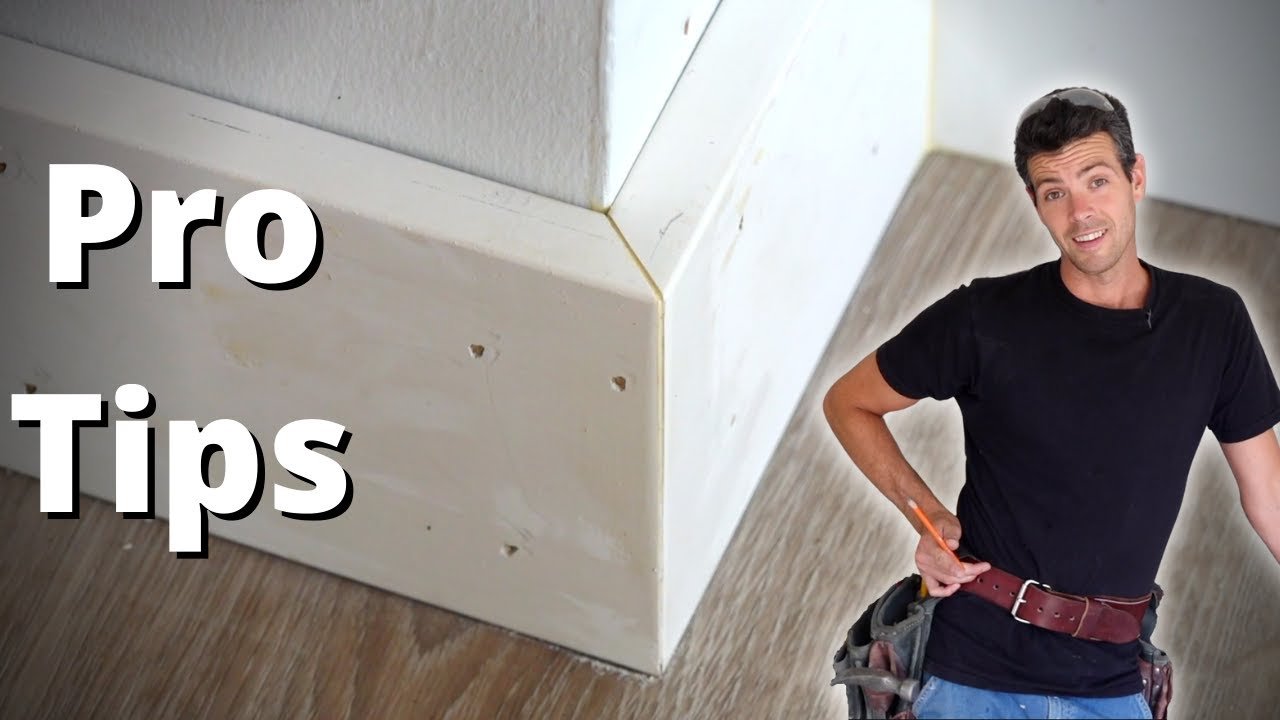
A carpenter installs 1×4 primed pine baseboard in a rental room, using mitered inside corners. He checks corner squareness with 45-degree test pieces, cuts inside corners at 44 and outside corners at 46 degrees, and glues and brad-nails the pieces. He also fixes an open outside miter with glue and sawdust.
Full written account
Installing baseboard in a rental room, a Vancouver carpenter works with primed pine 1×4, three quarter inch by three and a half inch. Flat stock like this he would usually cut square and butt into the corners, but here he miters the inside corners to show different information. Outside corners are mitered either way.
Checking the corners
Before measuring, he cuts a couple of spare pieces at 45 degrees and holds them in the corners to judge how square each one is. One corner is badly out of square, yet a 45 turned out not to be that bad there. He often cuts inside corners at 44 degrees and outside corners at 46. On an inside corner the tape and mud are built up, and on an outside corner the wall is built out, so the angles differ from 90 degrees in opposite directions.
Measuring and cutting
He measures from the inside corner, noting that mitered inside corners are a little easier to measure and mark. He warns to check the tape is not butting into a coved or built-up bottom corner, since tape and mud can build up about an inch above the floor. He checks the primed pine for paint flaws and uses the nicer side. The longest point of a cut is at the top, so he makes sure the board reaches it. To fine-tune a cut he holds the board against the fence and slides it a tiny amount by hand. He adds a small chamfer to the end of the board, marks the saw for it so every cut matches, and notes that it stops an ugly butt end. He says the saw blade needs replacing, and that cutting from the other side risks blowout. He also says moving trim around a finished room is why trim carpenters ding walls.
Gluing and nailing
He pushes the piece down before nailing and finds studs by trial, nailing into the bottom plate where he knows there is wood. Glue goes on the miters, sometimes spread over the whole face to avoid a starved joint, with a wet cloth at his belt. He says Weld Bond dries clear. He does not nail the corners first, since they can still be adjusted, and leaves good-looking joints un-nailed because nails can pull a corner in and open it. He reminds viewers that brad nails hitting a nail can spike out, and that it is good to know what is behind the wall, such as pipes.
Problem spots
Where a corner was not square he trimmed the back of a piece and used an angle grinder with a flap disc to notch one end. Where there may be nothing to nail to, he uses carpenter's helper filler, and caulking as an adhesive instead of PL because it wipes clean. He says installers on steel stud used caulking since brad nails only grab temporarily. An overhanging miter is sanded while the glue is wet, so the dust turns into filler. A final outside corner opened up, so he glued it, worked in sawdust and nailed the joint, expecting a couple of coats of paint to hide it.
Questions this video answers
What baseboard is installed?
Primed pine 1×4 flat stock, three quarter inch by three and a half inch.
How does he check whether corners are square?
He cuts a couple of pieces at 45 degrees and holds them in the corner to see how far out of square it is. He often cuts inside corners at 44 and outside corners at 46 because of the tape and mud build-up.
Why miter the inside corners?
Normally he butts the pieces with 90 degree cuts, except at outside miters. Here he miters the inside corners to show different information.
How does he fasten the baseboard?
He leaves the corners un-nailed at first so they can still be adjusted, and nails into studs or the bottom plate. Wood glue goes on the miters.
What does he use where there is nothing to nail to?
He uses caulking as an adhesive, as installers did on steel stud, because it wipes clean and doesn't squash out like PL.
Explore related projects
Connected by the topic: Carpentry