Floating Deck Build: Footings, Framing and Composite Decking
The short version
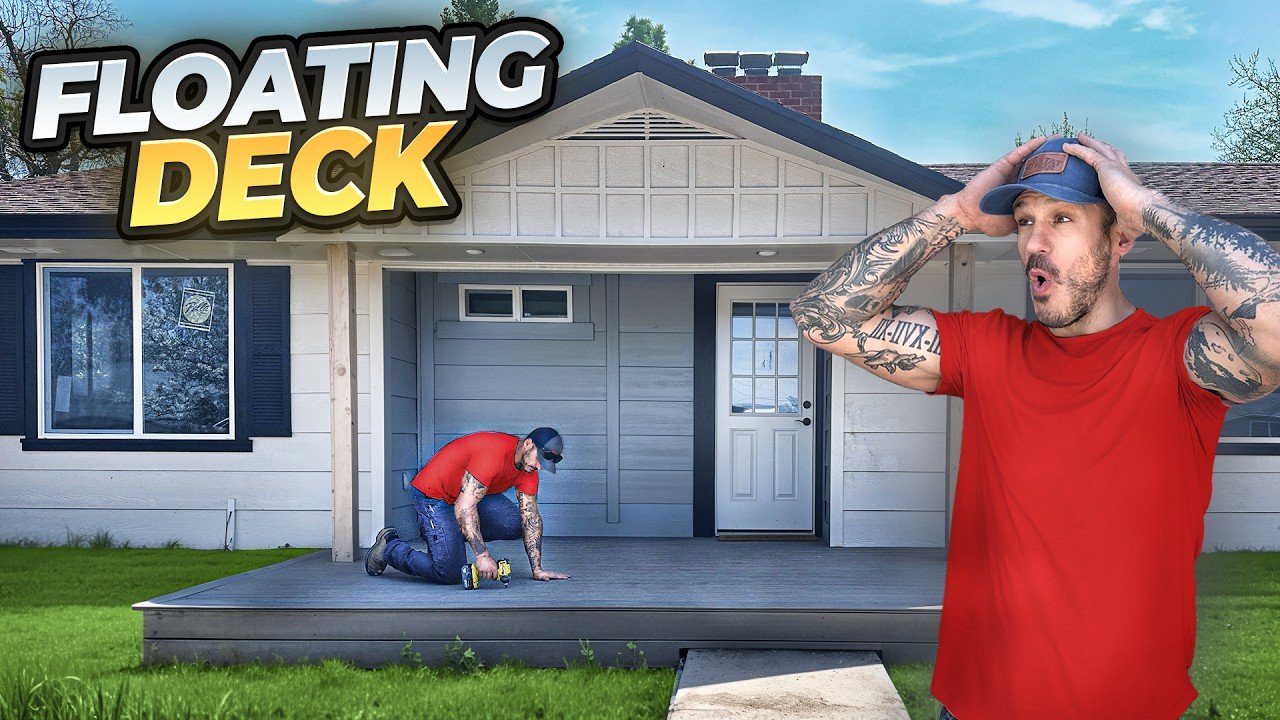
A floating deck is built at the front of an abandoned house as part of its curb-appeal work. The build covers excavating with a mini skid steer, pouring footings below the frost line, anchoring a pressure-treated 2×8 frame to the house with lag bolts, and laying TREX decking with hidden fasteners. Two posts are wrapped in cedar shiplap and finished with boiled linseed oil.
Full written account
A floating deck at the front of an abandoned house starts with clearing a weed-infested yard and ends with a composite-decked entrance and two cedar-wrapped posts. The decking alone cost almost $1,000: 28 boards, 16 ft long, at $35 each.
Clearing the site
The yard was scraped with a mini skid steer borrowed from a friend's rental business. It steers each track separately, and the bucket has no level gauge. A neighbor who owns a landscaping company pointed out the float setting: set the bucket flush with the ground, press the lever all the way down, and it holds there while you break up the soil and scoop it.
Footings
The plan was to extend the existing platform into a floating deck with a wraparound step section and two big posts. Concrete blocks set on the ground may work for a season or two, the builder says, but the ground eventually settles and moves. Instead, anchors go in concrete past the frost line. Stakes and string set the layout, and corner-to-corner measurements check that it is square.
An auger dug all three holes in about 8 minutes, despite roots and a tree stump on the first. Rocks went in the bottom for drainage so water does not pool and lift the footings. A string across the anchors kept them lined up with the back of the house.
Framing
The frame is pressure-treated 2×8 lumber, bought after a first trip for 2x10s by mistake. It is anchored to the house footing with lag bolts, drilled using an SDS hammer drill. Using an impact driver on the expansion anchors stopped them from pressurizing properly, and one had to be redone. The joists are spaced 16 inches on center, with blocking added where long boards would not support the framed section. An extra pair of 2x8s on hangers reinforced a flexing section.
Temporary 4×4 posts helped level the frame with the existing patio deck before being cut off. The two decorative posts are not load bearing. One was fixed through a cut hole and blocked against the attic rafters.
Decking
The decking has slots for a hidden hardware kit with spacer clips and screws, so no screws show on top and no sanding or staining is needed every two years. The hardware costs roughly 40 to 50 dollars a box, and several boxes are needed. The border has mitered corners, and a track saw cut the long boards. The builder says he is not sponsored by the hardware maker.
Finish
The posts were wrapped in cedar shiplap with wood glue and outdoor screws; the tongue and groove was cut off. The plan is a coat of boiled linseed oil to bring out the amber tone.
The builder also says cheaper Douglas fir can work if kept off the ground, treated with weatherproofing paste and covered with flashing, but he expects to pay for the savings in prep time.
Explore related projects
Connected by the topic: Build a deck