Extending a Shed Roofline 10 Feet With 6×6 Posts and Spliced Shingles
The short version
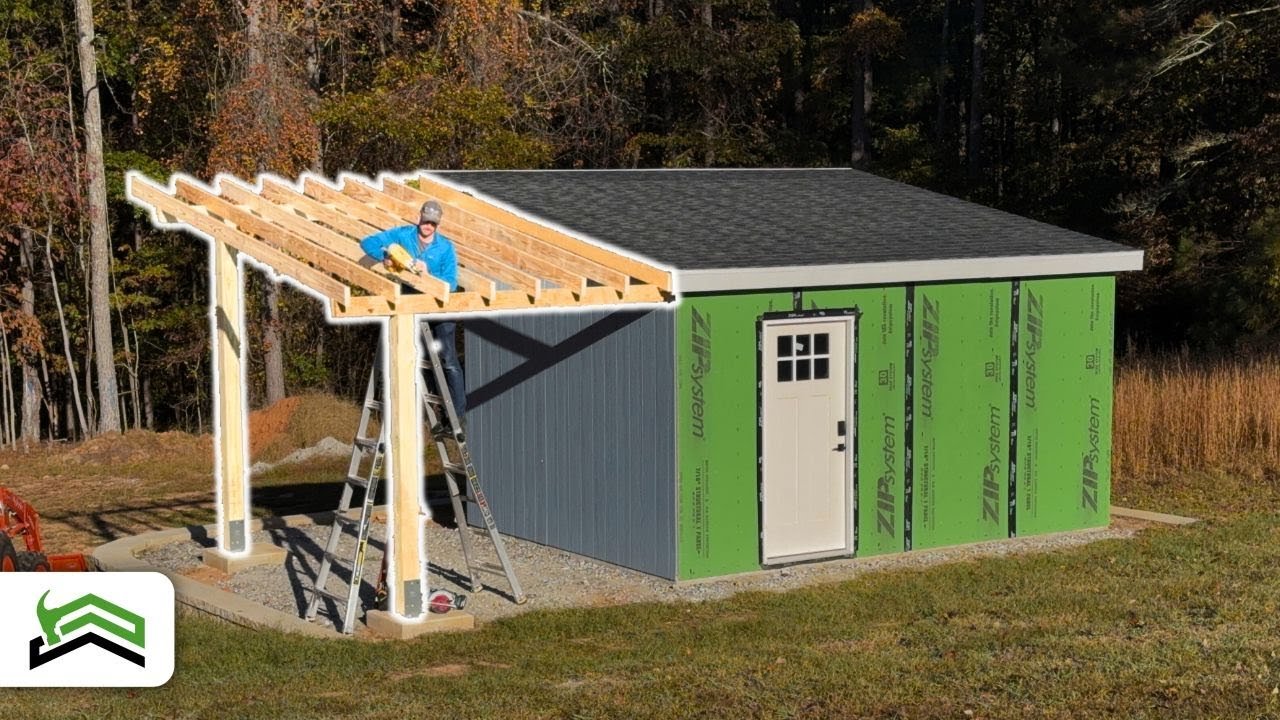
Scott of Everyday Home Repairs extends the roofline of a 12×16 modern single-slope shed by about 10 feet, as part of the Solar Shed 2.0 project. He builds 2×6 headers, sets 6×6 posts on brackets and notches them to carry the beams, cuts birdsmouth rafters, decks with ZIP board and splices new shingles into the existing roof. The covered space is meant to park a Kubota tractor.
Full written account
Scott of Everyday Home Repairs set out to add about 10 feet to the roof of a 12×16 modern shed, a single-slope lean-to, so a 25 horsepower Kubota tractor could park underneath. The shed is part of his Solar Shed 2.0 project, a conversion of a storage shed into a home office, with the entire roofline planned to be filled with solar panels.
Why extend the roof this way
A simple lean-to sloping out toward the tractor would have been the easiest option, he says. He needed at least 91 inches of height on the low side to clear the tractor's rollover protection bar, and a single slope keeps the solar panel install clean. The high-side post is about 10 feet tall.
Tying into the shed
The new structure ties in with a 2×6 header. He had already removed the 8 in. soffit, left the roof deck in place, and used an oscillating tool with a demo blade to cut the exact header dimensions into the back and front walls. The siding is LP Smart Siding, with green ZIP board where the space will be heated and cooled.
The beams are two 10 ft 2x6s with 5 1/4 in. wide strips of ZIP board between them, joined with 3 in. nails. He notes a 10 ft board is usually about an inch off, so it should be measured and trimmed. Construction adhesive between the boards is an option for more strength.
Posts and footings
The 6×6 pressure-treated posts stand on previously poured concrete footings about 8 ft off the wall. The frost line there is only about 12 in. deep, and he tells viewers to check their own. After drilling 3/8 in. holes, he drove Simpson Strong-Tie Titan HD 1/2 in. anchors, four per bracket, with an impact driver. Posts were held temporarily with lags, with carriage bolts to follow, and composite shims can bring them plumb.
Notching and rafters
He levelled each beam with a 4 ft level, marked the post and notched it 3 1/2 in., the beam thickness. His reasoning: the load then sits on the post instead of on lags. On the shed side he used 6 in. Simpson hurricane screws.
A rafter removed from the soffit served as a template for the birdsmouth cuts, made with a circular saw and finished with a jigsaw. Rafters sit 16 in. on center, each with three 3 in. toenails per beam. A 2×6 fascia board went on next.
Decking and shingles
ZIP board and seam tape replace tar paper or synthetic underlayment. He also taped underneath the old edge. The starter strip runs under the old architectural shingles to avoid stacked seams. Old courses are lifted with a flat bar, about five at a time, to break the tar seal so it can reseal onto new shingles. He used four to six nails per shingle, staying within the nailer strip, and says to check the manufacturer's guidance, especially in high-wind regions. On a lean-to, the top drip edge goes over the shingles and nail holes are sealed with silicone. Six-inch aluminum fascia finishes the edge, and he says the tractor fits.
Questions this video answers
Why notch the posts for the beam?
The video says notching a 4×4 or 6×6 post lets the load sit on the post rather than on fasteners like lags.
How are the beams built?
Two 10 ft 2x6s with 5 1/4 in. wide strips of 1/2 in. ZIP board between them, joined with 3 in. nails.
Why use ZIP board?
It serves as sheathing and a water barrier, and the space will be heated and cooled. On the roof it replaces tar paper or synthetic underlayment when seams are taped.
How should the new shingles tie in?
The starter strip goes under the old architectural shingles to avoid stacked seams, and old courses are worked loose with a flat bar, about five courses at a time.
How long does shingling take?
The video says it should only take a couple of hours to get this many shingles on.
Explore related projects
Connected by the topic: Build a shed