Outdoor Grill Station Built With Metal Studs and Stone Veneer
The short version
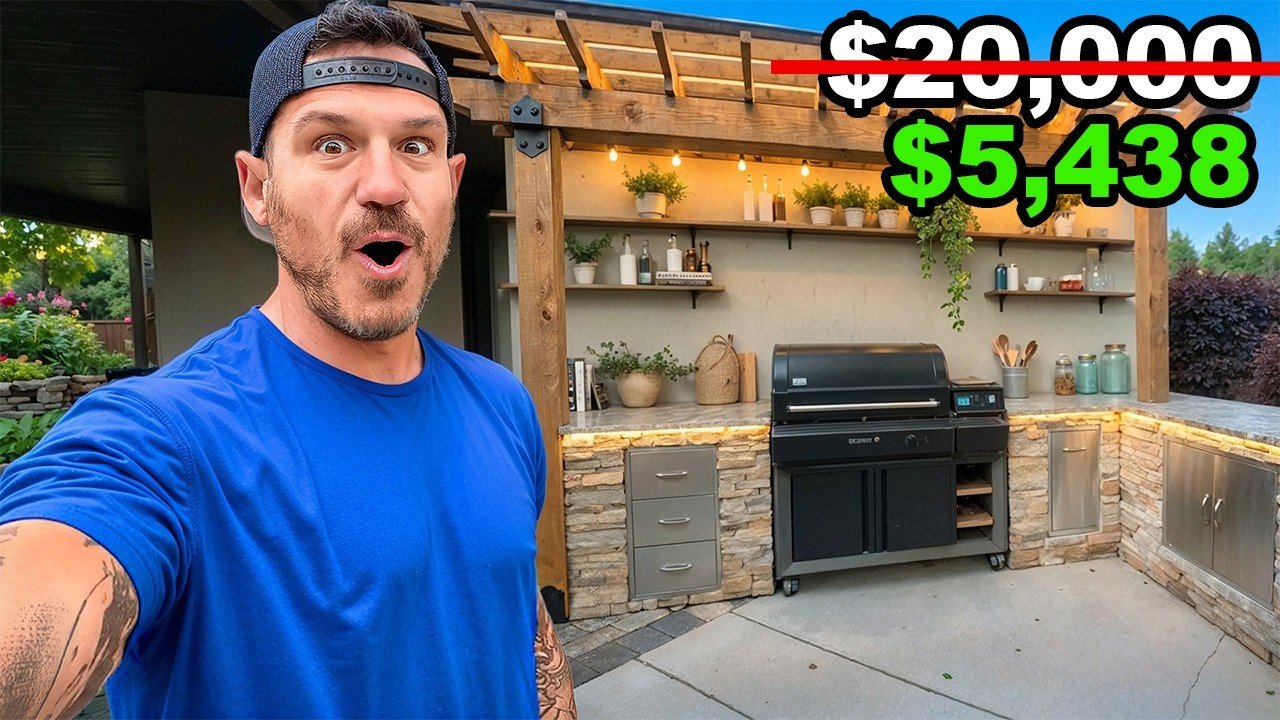
Alex of Mr. Build It replaces a basic grill-against-the-wall setup with an L-shaped built-in grill station. He frames it with metal studs, covers it with cement board, installs VEVOR outdoor cabinets, and finishes it with stone veneer and countertops. The project took over a month because of scheduling delays, including countertop installers who did not show up on the first date.
Full written account
A backyard grill sitting against a wall became an L-shaped built-in station in a build by Alex of Mr. Build It, framed in metal studs and finished in stone veneer. The project took over a month because of scheduling delays, and the countertop installers did not show up on their first date.
The plan
The layout calls for large countertops on the left and right and an L-shape with room for a pizza oven, a Green Egg or a Blackstone. Storage includes a metal cabinet with a trash chute, a cabinet with paper towels and pull-out drawers for utensils, and a large cabinet for a propane tank. He also wants an accent wall, possibly floating shelves, and is considering granite or quartz countertops.
Framing with metal studs
He frames the base with metal studs because they are least likely to catch fire and handle rain better than pressure-treated lumber. Granite countertops run about 1 1/4 in. thick, so he subtracts that from his 36 in. target height so the finished counter sits flush with the open grill. He checks square by measuring corner to corner, finding 65 1/2 against 65 5/8, off by an eighth. He treats the metal framing as 16 in. on center and adds braces cut from track to keep the top from spreading under the stone.
He first said metal studs cost about the same as wood, then corrected that. Studs were about $7 for an 8 ft stick, and the track about $10, against $4-5 for Douglas fir. His tips:
- A magnetized bit with a fine tip makes phosphate-coated screws easier to drive.
- A portable bandsaw cuts metal with no sparks or flying pieces.
- A circular saw with a metal cutting bit also works, and is easier than an angle grinder.
Cement board and cabinets
He picks a classic cement board over Hardie board, which he says is not rated for outside use. The classic board is more brittle and has mesh inside. He tries scoring it with a utility knife and keeps a reciprocating saw or circular saw with a carbide-tip blade as a fallback.
The cabinets are VEVOR units from Amazon, chosen over costlier outdoor-kitchen cabinets. They arrive assembled. A single door unit is about $80. One cabinet does not fit at first because of an elevation error on his part: he measures 14 3/4 in. against 15 in. and plans to lower the bottom piece. He likes the quality but dislikes the VEVOR logo and support website printed on the face, and he has no screw holes in the sides to secure them.
Stone veneer
The stone is a Chop ledge panel in Sea Pearl, with corner pieces. When ordering, he says to calculate both square footage and linear feet of corners; he counted about nine linear feet. He mixes the mortar to a sour cream consistency, wets the back of each stone with a spray bottle to slow curing, and spreads mortar about an inch thick. Each piece gets a quick press to hold by vacuum pressure.
His advice for amateurs is to do the corners and the level at the same time, sequence by sequence, rather than finishing all the corners first. Where the stone had to fit against other stone, he scribed the cut with a Sharpie and made several passes on a tile saw. At one spot he skipped a corner piece because the gaps were about an eighth on each side, used a regular piece checked with a speed square, and planned to caulk it, with the countertop overlapping to hide it. Blue tape on the stainless steel proved hard to remove, and pressure washing was his fallback.
Countertops
The countertops were measured and due to be installed while he was away at a Ryobi event in Greenville, South Carolina. On his return no one had shown up, and installers came about a week later. He then planned floating shelves and decor.
Questions this video answers
Why did he use metal studs?
He says metal is least likely to catch fire and holds up to moisture better than pressure-treated lumber, which he was uneasy about using near a hot grill.
Are metal studs more expensive than wood?
He first said they were close, then corrected himself: studs were about $7 each for an 8 ft stick and track about $10, against $4-5 for Douglas fir.
What cement board did he use?
A classic cement board, because he says Hardie board is not rated for outside use.
How should stone veneer mortar be mixed?
To about a sour cream consistency, spread about an inch thick, with the back of the stone wetted from a spray bottle to slow curing.
How long did the project take?
Over a month, because of scheduling delays.
Explore related projects
Connected by the topic: Cabinets and countertops