Building a U-Shaped Outdoor Patio Sectional From Douglas Fir
The short version
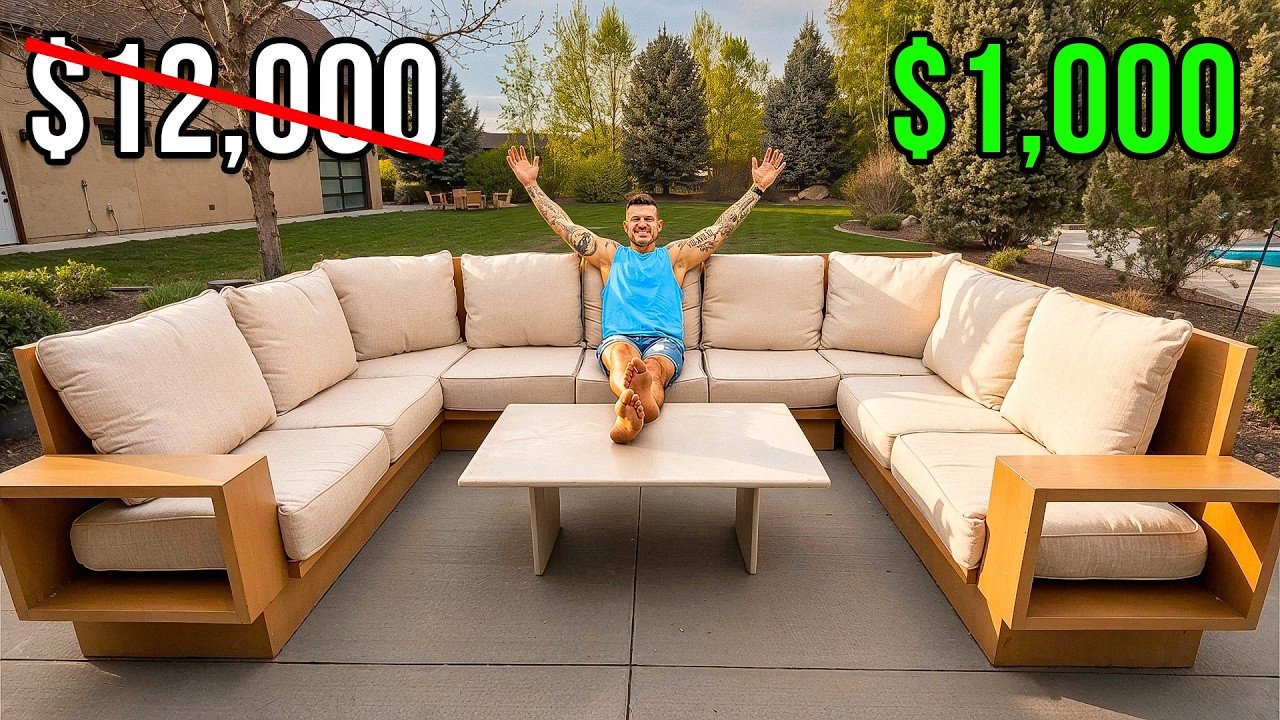
The creator builds a U-shaped outdoor patio sectional from Douglas fir, aiming to copy a $12,000 design for about $1,000. The build uses pocket holes, Titebond 3 glue, and WoodWeld epoxy to fill screw holes and knots, followed by primer and exterior paint. The final budget was $1,230, and the result seats nine people.
Full written account
A $12,000 outdoor sectional was the model for a U-shaped patio build that finished at $1,230 in materials, against a goal of about $1,000. The creator built it from Douglas fir and added an extra middle section, which gave a nine-person seating arrangement.
Designing backwards from the cushions
The build started with the cushions: eight pieces, 24 by 24 in., 6 in. thick, ordered from Amazon. The creator says cheaper cushions are around 4 in. thick and that thicker is better. The 6 in. cushion plus the seat base sets the backrest height at 27 in. The plan was two couches and two filler seats.
Prep and joinery
Douglas fir was chosen and, since it is hard to stain because of its red pigment, it was to be painted. Staples have to be pulled from the lumber with pliers before it goes through a jointer or thickness planer, because a broken staple can ruin the knives. Backrest panels were spaced about an eighth of an inch apart, joined with Titebond 3 glue, which is waterproof, and exterior-grade coated pocket screws. The pocket holes face the back so the cushions cover them, and the exposed side used the boards with the fewest knots.
Glue goes on both surfaces for a better bond, much like mortar on both wall and tile. The filler pieces get pocket holes on both sides but no glue, so the sections can be taken apart and moved.
A paid sanding session
Instead of a day of sanding, the creator took the panels to Wood Labs in Eagle, near Boise. The visit lasted 27 minutes and cost $305: about $150 for setup, $120 for the hour and about $30 for the belt. This was not counted in the $1,000 budget.
Bases and a fix
The bases use 2×4 frames, cleats that hold a slatted seat bottom, and a center brace with a peg for support. Because the original design assumed 10 in. cushions, a 2×8 was used at the bottom to make up the height. The armrests, built by eye, came out too tall, so they were unscrewed and cut down with a Japanese handsaw.
Epoxy and finish
Water getting into screw holes is called one of the biggest dangers for outdoor furniture. Instead of wood filler, which the creator says cracks with temperature changes, the screw holes and exposed knots were filled with J-B Weld WoodWeld, a two-part epoxy, then sanded with 150-grit paper. After primer, a light hand sanding with 220 grit knocks down raised wood fibers, giving a glass-like final coat. The paint is Sherwin-Williams Hopsack, an exterior-grade paint chosen to match an outdoor dining table.
The extra cost came from another gallon of paint, extra boards and the added middle cushion.
Questions this video answers
How much did the sectional cost to build?
The stated budget total was $1,230, over the $1,000 goal. The $305 sanding rental was not included.
What wood was used?
Douglas fir, plus 2x4s and 2x8s for the bases.
Why use epoxy on the screw holes?
The creator says wood filler eventually cracks with changing temperatures, and WoodWeld is waterproof and gives a more permanent fix.
What paint color was used?
Sherwin-Williams Hopsack in an exterior-grade paint.
How many people does it seat?
Nine, after an extra middle section was added.
Explore related projects
Connected by the topic: Carpentry