Building a Storage Window Seat with a Butcher Block Lid
The short version
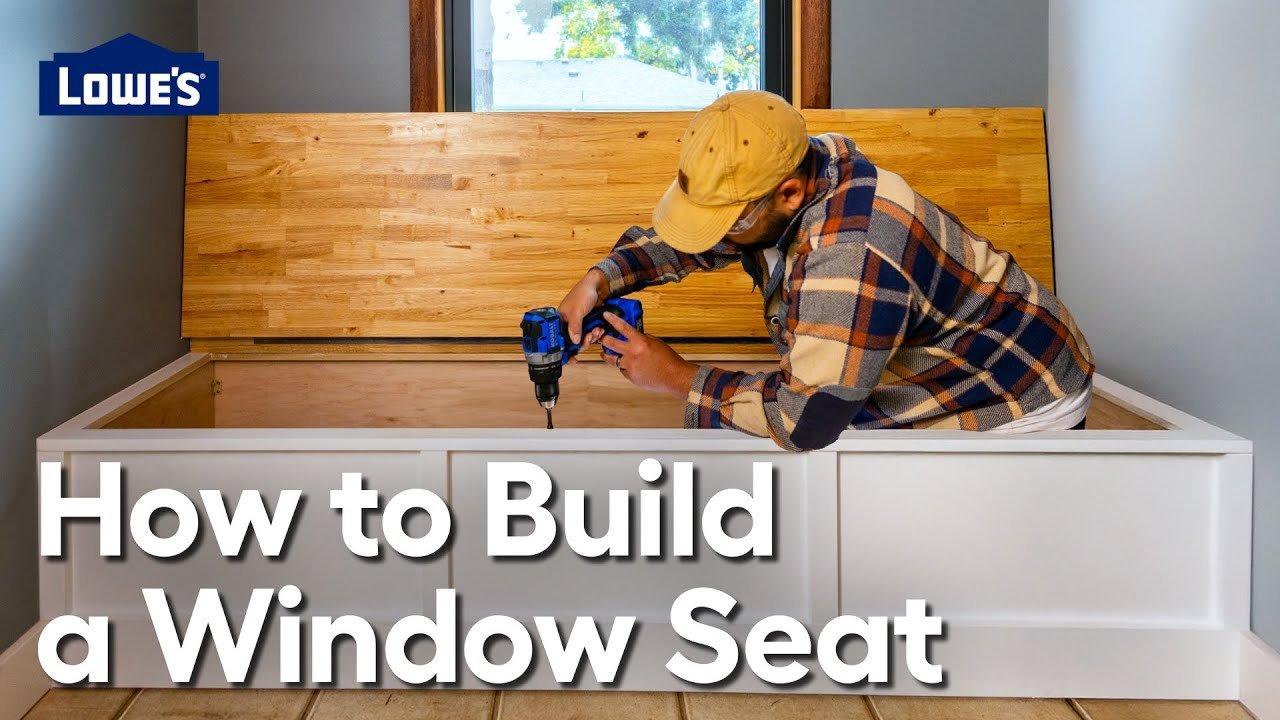
A Lowe's associate guides homeowners Savannah and Michael through building a hinged-lid storage window seat for their mudroom. The seat is 77 in. long and 21 in. deep, built from poplar boards and plywood, topped with a shellac-sealed butcher block lid on two piano hinges, then finished with baseboard, trim, paint and beadboard.
Full written account
Savannah and Michael, owners of a small first home, had a completely empty mudroom and a window looking out on the garden, a mountain and trees. They wanted a place for shoes, jackets, keys and purses, and a more welcoming main entrance. Working with Kyle, a Lowe's associate, they built a window seat with storage under a hinged lid.
Measuring and cutting
A standard bench is 18 inches tall, so the pair needed only the length and depth. They settled on about 77 in. long and 21 in. deep for a roomy seat. Lumber was cut to the plan: base frame, vertical supports, top rails and siding. They bought 1×6 and 1×2 poplar boards for supports and rails, and plywood for the siding.
A miter saw handled the poplar cuts, with the blade kept running all the way through for a clean finish. A circular saw cut the longer plywood side pieces. Every piece was sanded with a 220 grit sandpaper block.
Assembling the base
The plywood siding goes in first. Cabinet screws and braces join each corner, and pilot holes drilled beforehand keep the screws from splitting the wood. The base walls are assembled into a box.
The rails along the top edge support the butcher block lid. The back rail is glued down first, because the hinged top attaches there and it needs extra support. A countersink bit makes room so the screw heads sit flush. The remaining rails are attached with a nail gun, since the lid simply rests on them. Nail holes are filled with wood filler, and a baseboard and trim added with the nail gun help give a built-in look.
Paint
After a drop cloth went down, the base was primed and given two coats of paint, with each coat left a night to dry. Savannah and Michael chose the color Snowbound.
The butcher block lid
The butcher block was cut to the exact width of the bench with a circular saw, slowly. A slim piece the same length as the bench top forms the back edge. Two piano hinges join the two, with pilot holes drilled first and paint stir sticks used to leave space between the pieces so the hinges have room.
The top was wiped with a microfiber cloth and a tack cloth, then sealed with shellac, which protects the wood from moisture while keeping the grain visible. The lid is attached to the back rail from underneath, and tested to confirm it opens smoothly.
Finishing touches
Beadboard was cut to size and nailed to the wall, with trim along its top edge, painted to match the bench. The couple said they liked having storage that isn't visible, and Michael named the trim as his favorite part.
Questions this video answers
How tall is a standard bench?
The video says a standard bench is 18 inches tall.
What size is the window seat?
About 77 in. long and 21 in. deep.
What wood is used?
1×6 and 1×2 poplar boards for the supports and rails, plywood for the siding, and butcher block for the lid.
How is the lid attached?
Two piano hinges connect the lid to a slim back piece, which is screwed to the back rail from underneath.
How is the butcher block protected?
With shellac, which protects it from moisture and keeps the wood grain visible.
Explore related projects
Connected by the topic: Carpentry