How To Make TERRAZZO using Glass, Rocks, & Broken Tile!
The short version
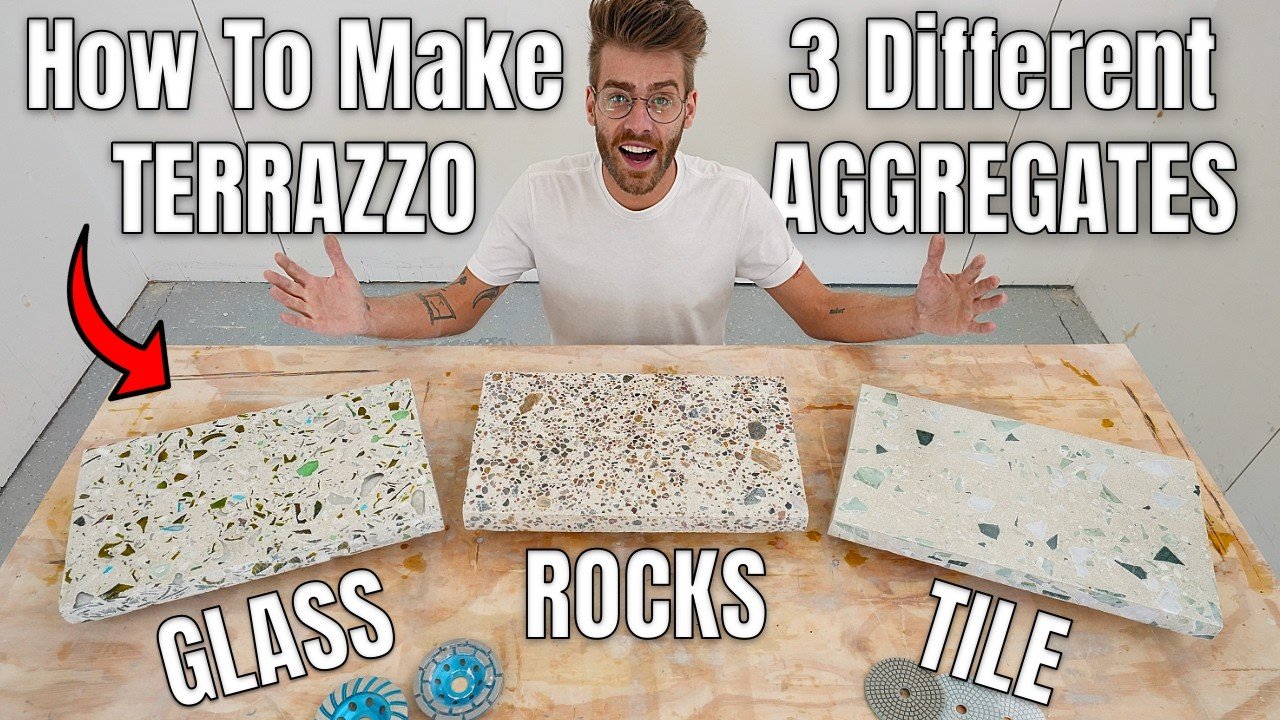
Three small terrazzo test slabs are cast in white concrete using a 3:2:1 mix of aggregate, sand and white Portland cement. The aggregates are broken glass bottles, gathered rocks and stones, and broken marble tile. The slabs are ground with 4 in. and 4 1/2 in. grinding wheels, honed and wet-sanded through diamond pads up to 3000 grit, given a slurry coat, and sealed with three coats of Glaze 'N' Seal. The creator prefers the marble slab and says the slurry coat mostly did not stick.
Full written account
Three stepping-stone-sized terrazzo slabs, each cast in white concrete with a different aggregate, are the test pieces in this experiment: recycled glass bottles, rocks and stones gathered from the creator's property, and broken marble tile. The molds are made from 3/4 in. melamine cut with a circular saw and speed square, each roughly 18 by 22 in. Side walls cut to 2 1/4 in. give a finished slab about an inch and a half thick. They are screwed together with 1 1/4 in. trim head screws and coated with paste wax so the terrazzo releases.
Three aggregates, one mix
All three pours use the same ratio: three parts aggregate, two parts sand and one part white Portland cement, measured in solo cups. The target consistency is like peanut butter or pancake mix. Too little water leaves it powdery and prone to cracking, and too much makes it brittle. Three pieces of 3/8 in. rebar go into the middle of each slab.
For the glass slab, bottles in green, clear, brown and bright blue had their labels softened with a heat gun and the residue removed with paint thinner. They were broken and then hammered into smaller pieces. The creator says he should have worn goggles. The rocks were crushed, put in a 5-gallon bucket with holes drilled in the bottom, and washed with a garden hose. The marble slab used broken green marble tile, Carrera marble and some dark green pieces. The box of broken tile came at 50% off from Floor and Decor.
The top of each pour is the show face. Selected pieces and fine chips were sprinkled on top and pressed in with a screeding board. Air bubbles were knocked out with hammers. On the tile slab, pieces were laid flat so the straight edges would not show as lines.
Grinding
The slabs were ground while still in the melamine, which he hoped would prevent cracking. He recommends a respirator, ventilation and goggles. A 4 in. grinding wheel fit inside the guard of the angle grinder. The 4 1/2 in. wheel needed the guard removed, which he says he does not recommend, but it left less aggressive marks and a flatter result because of its larger reference area. In a couple of spots the glass popped out of the concrete. The marble slab gave the best result of the three, which he suggests is because marble is soft and close in hardness to the concrete mix. Edges ground fairly square.
Honing, slurry coat and polishing
Diamond polishing pads ran from 50 grit to 6,000. The 50 grit still removed a moderate amount of material. The slurry coat was one part Portland cement to two parts sand. It was applied thick on glass, thin on rocks and medium on marble. On the glass slab nearly all of it tore away under the 50-grit pad. The 200-grit pad kept more, and the medium coat on the marble was best. He concluded that starting at 200 or 300 grit is better, and wishes he had sanded through 50, 100 and 200 before the slurry coat.
After 400 grit he was finally making fine dust rather than removing material. Wet sanding with 800, 1500 and 3000 grit used a garden hose rig. He says he does not know whether an angle grinder around water is dangerous and tells viewers not to copy him. After 600 grit he saw no difference between 1500 and 3000.
Sealing and results
He applied three coats of Glaze 'N' Seal, a medium gloss finish, with an applicator pad, about an hour apart, and hand-sanded with the 6,000-grit block between coats. Small scratches remained on some larger stones and marble pieces. The glass slab came out worse than the others, and he says he should have begun polishing at a higher grit. He rates the glass slab as looking better than expected, the rocks second, and the green marble tile first. He plans to use the technique on a countertop or table.
Questions this video answers
What concrete mix does the video use?
A 3:2:1 ratio of aggregate, sand and white Portland cement, measured in solo cups, mixed to a peanut butter or pancake mix consistency.
How thick are the slabs?
The molds are about 18 by 22 in. with 2 1/4 in. side walls, giving a finished slab about an inch and a half thick.
Which grinding wheel worked better?
The 4 1/2 in. wheel gave a flatter result with less aggressive grinder marks than the 4 in. wheel, but it required removing the angle grinder guard, which he does not recommend.
Did the slurry coat work?
Mostly not. With the 50 grit pad nearly all of it tore away; the 200 grit pad worked better, and the medium coat on the marble slab gave the best result.
Which slab did he like best?
The broken green marble tile slab was his favorite, then rocks and stones, then glass.
What finish was used?
Three coats of Glaze 'N' Seal, a medium gloss finish, with about an hour between coats.
Explore related projects
Connected by the topic: Cabinets and countertops