How to Strip, Clean and Restain a Weathered Deck Step by Step
The short version
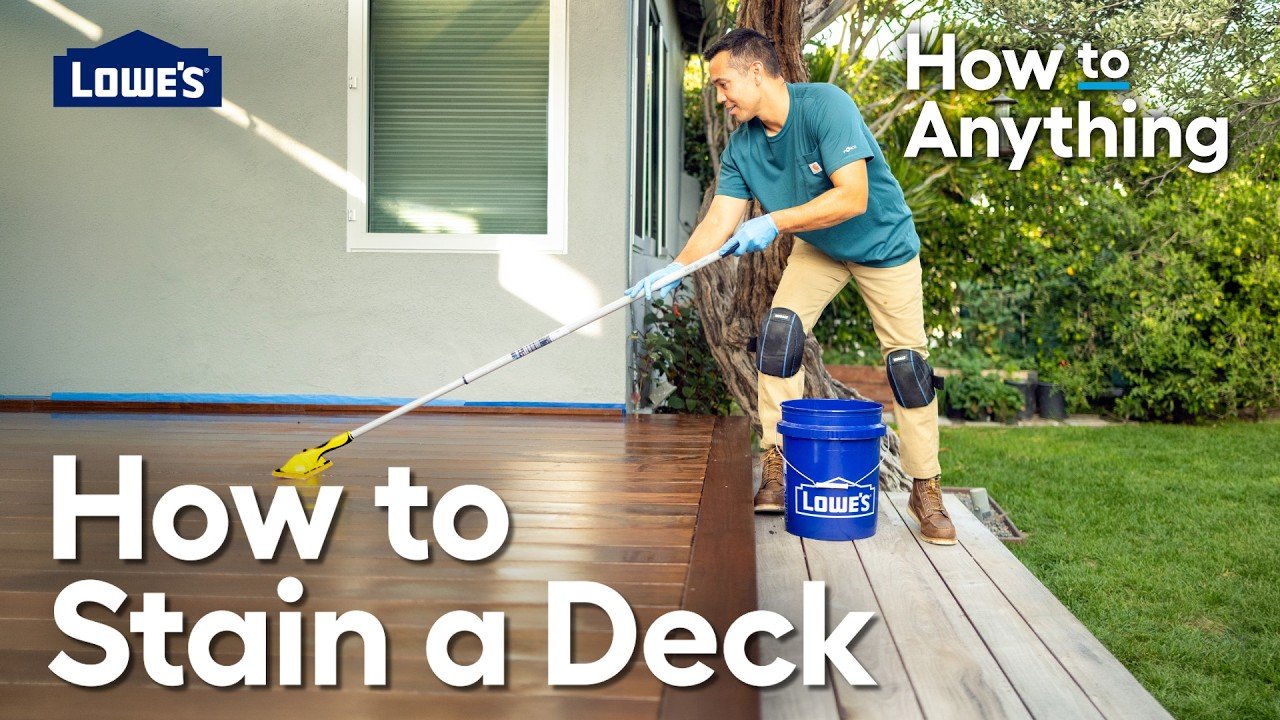
Ricky from Lowe's shows how to refinish a weathered deck. He checks whether the old stain still protects with a water bead test, strips the old stain with a pressure-washer-applied wood stripper, cleans with an all-in-one wood prep, waits 48 hours to dry, sands spots, tapes off, and applies a one-coat stain and sealer with a pad. Stairs fascia is sprayed with an airless sprayer, and a final water test shows beading.
Full written account
A simple bottle of water is the first test Ricky uses to decide whether a deck needs refinishing: pour it on the boards, and if it soaks in instead of beading, the stain is no longer protecting. On the gray, weathered deck in this Lowe's How To Anything episode, the water soaked in directly, and the same test is repeated at the end of the job.
Prep and board repair
The furniture is removed and dust and debris blown off. Before any intensive cleaning, the deck is checked for boards that need repair. This one is in good shape, but for a bad board the nails or screws come out, the board is removed, the opening is measured with a tape measure, and the new board is cut to leave about 1/8 inch of gap.
Stripping the old stain
Valspar Fast Acting Wood Stripper goes into a pressure washer and onto the whole deck, then a stiff push broom agitates the old sealer. It sits for 15 minutes. The deck must be misted during that time, because if the sun dries the stripper, dark spots result. Because the whole deck gets wet and is stained later, the forecast should show sunshine for the next few days.
Pressure washing technique
The white tip, a 40° tip, covers a lot of deck without tearing it up. Keep the same height for the whole stroke and lift at the end, which is called feathering. Never turn the pressure washer on or off directly on the deck, which can gouge the wood. Near the house, where the strokes run against the grain, stay a little farther away. Overlap strokes at least 50%. A garden hose then rinses off stripper residue, with extra attention to plants near the house.
Cleaning and drying
While the deck is still wet, Valspar All-in-One Wood Prep is applied with the pressure washer. It cleans, brightens, and helps remove stains and rust. After 15 minutes it is rinsed off. Because wood is so absorbent, the deck then dries for at least 48 hours.
Sanding, taping, and staining
Spots the stripper missed are sanded with a random orbital sander and fine sandpaper, feathered into the rest of the deck, and dust is blown off with a leaf blower. The house is taped off and other areas covered with contractor's paper, which absorbs stain, whereas plastic lets stain sit and run down.
The stain is Valspar One-Coat Exterior Stain and Sealer. A smaller pad does the corner and a 9-inch pad the larger areas. A roller doesn't hold the stain and splashes it. Hold the pad for about a second to drain some stain, work with the grain, pad out puddles with a dry pad since puddles solidify and never soak in, and work in sections, especially in sun, so the stain blends.
Stairs and final test
The vertical fascia is sprayed with an airless sprayer and backed up with a pad. Without a sprayer, stain in a spray bottle can be sprayed on and patted out. Spraying makes sense because of the many 90° angles and nooks. The final water test shows the water beading up.
Questions this video answers
How do you know if a deck needs restaining?
Pour water on the deck. If it beads up, the stain is probably still protecting; if it soaks in, it is time to refinish.
How long should the wood stripper sit?
15 minutes, and the deck should be misted so the sun does not dry the stripper, which can cause dark spots.
How long should the deck dry before staining?
At least 48 hours after stripping and cleaning.
Why use a pad instead of a roller?
A roller does not hold the stain and splashes it, while the pad has a sponge that soaks up the stain.
Why use paper instead of plastic to cover areas?
Paper absorbs the stain, while plastic lets it sit and run down.
Explore related projects
Connected by the topic: Carpentry