Ipe Deck Boards and a Dovetail Railing on a 20×20 Deck
The short version
Tom Silva guides homeowners Melissa and Mark through finishing a 20 by 20 deck. They lay factory-stained ipe decking with hidden fasteners, then build a 4×4 post and 2×4 rail railing joined with routed sliding dovetails and finished with 2×2 balusters.
Full written account
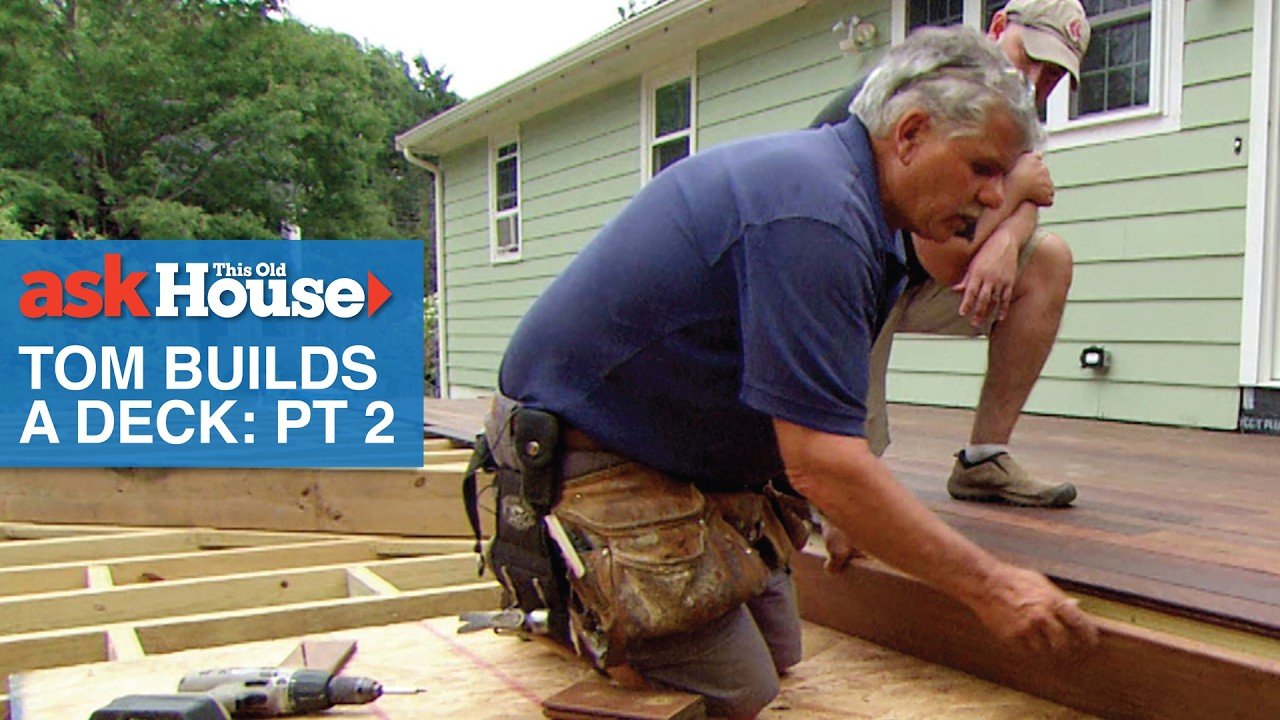
Tom Silva and homeowners Melissa and Mark finish a 20 by 20 deck, about 400 square feet, in the second half of a two-part build. The decking is ipe, a dense Brazilian hardwood, and the railing joins its 2×4 rails to 4×4 posts with routed sliding dovetails.
Checking the frame
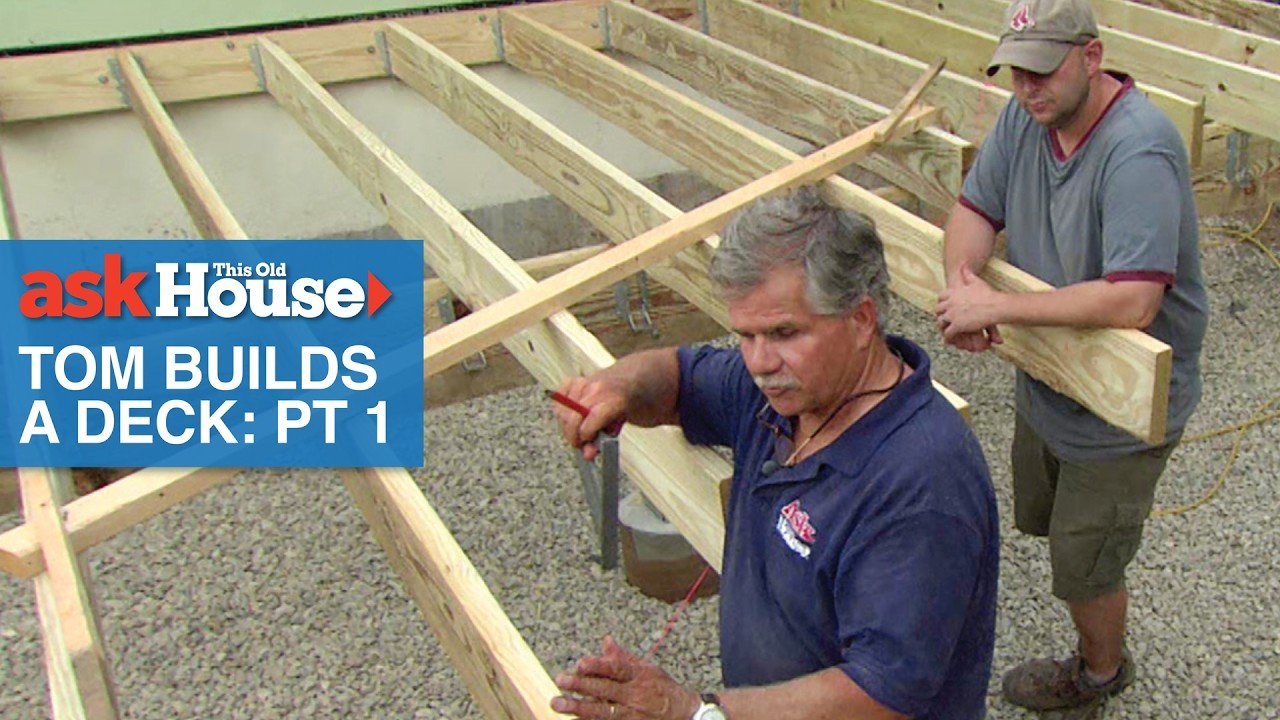
Before decking, Silva inspects the homeowners' work: joists, rim joists, cut joist ends and blocking, which keeps the joists true and straight. The stringers rest on a poured concrete pad with a 2×12 plate J-bolted on top, anchored with an angle bracket and adjustable joist hangers, with carriage bolts. The homeowners say it took about six tries, leaving a pile of discarded stringers.
Laying the decking
Ipe, also called ironwood, holds up to weather and ages to a silvery gray, but the owners chose a darker, richer stain applied at the factory, which covers all the way around the board. About 450 square feet was allotted for waste.
A chalk line is snapped parallel to the house. Because the wood is so hard, the first board is pre-drilled and face screwed with a color-matched screw, and the board's curve is pulled out to the line. Farther from the house, boards are fastened with a hidden system: a nail driven through the groove with a pneumatic decking tool, with a small piece that acts as a spacer and holds the next board. A mallet drives each board onto the fasteners.
Butt joints must end in the center of a joist, not the center of a joist bay, and fresh cuts are sealed to prevent checking or cracking. Where nailing might split the boards, a plastic biscuit with two spacers goes into the slot and a stainless steel screw is driven through it. The last board on the level is face screwed, and side boards run long and are cut flush with the rim joist.
At the step down, 1×8 ipe with mitered ends and sealed end grain hides the pressure-treated framing and the groove, over a filler piece of ipe scrap.
Railing with sliding dovetails
The railing uses 4×4 posts, 2×4 rails and 2×2 balusters. Each post has a half lap at the bottom that sits against the structure and on the deck, and is bolted with 5-inch lag bolts, plumbed with a level. Silva chose a sliding dovetail because it is strong and the rail cannot pull out, and a shelf holds the rail if someone steps on it.
A jig keeps every post identical. A router with a half-inch dovetail bit pitched at eight degrees and a templating collar cuts the dovetail. A second router with a straight bit and wider collar removes most of the wood to spare the dovetail bit, since ipe is tough on bits. The half lap is cut on a table saw using a reference line on the rip fence, then the waste is broken out and cleaned up with a chisel and hammer.
Rail ends are cut with the same router, bit, collar and depth but a jig that fits over the 2×4 end. End grain is sealed, and a strap ratchets a curved post back into place. Because the dovetail does not stop sliding along its length, two galvanized pins go in the corner. Corner gaps between two posts are filled with mitered 2×4 pieces, fixed with a stainless steel screw.
Balusters
Each baluster section is built on a table and installed as a unit. The layout starts about four inches from the post, then alternates a two-inch space and a four-inch space. Two marked nailing sticks, top and bottom, position the balusters, which are pinned with 1-inch 18-gauge nails, four at top and four at bottom. Longer nails would bend in the hard wood. The last task is to put blocks on top of each post.
Questions this video answers
What decking material is used?
Ipe, also known as ironwood, a dense Brazilian hardwood. The factory stained it so the stain covers all the way around each board.
How big is the deck?
The deck is 20 by 20, about 400 square feet, and 450 square feet of decking was allotted to allow for waste.
How are the deck boards fastened?
A pneumatic tool designed for decking drives a hidden fastener through the groove of each board. The first and last boards cannot use it and are face screwed.
Where should deck board ends land?
Ends should land on the center of a joist, not in the center of a joist bay, and the fresh cut should be sealed to prevent checking or cracking.
How is the railing built?
Posts are 4×4 with a half lap at the bottom bolted on with 5-inch lag bolts. The rails are 2×4 and slide into dovetails routed in the posts, and the balusters are 2×2.
Explore related projects
Connected by the topic: Build a deck