Plastic vs Metal Storage Sheds: Assembly Time, Headroom, Anchoring
The short version
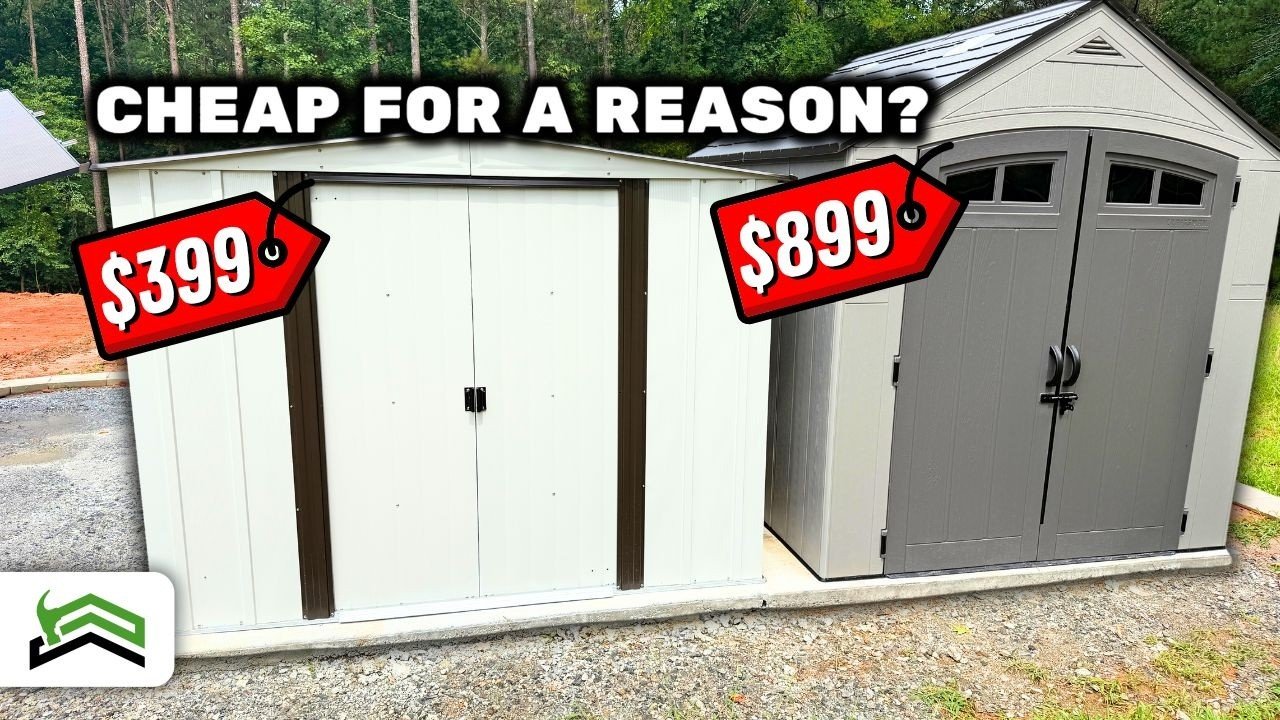
Scott assembles a plastic (resin) Suncast-made Craftsman shed and a metal shed to compare them. The plastic shed took about 3.5 hours to assemble and the metal one 7.5 hours, with far less headroom in the metal shed. He recommends a concrete slab or a pressure-treated 2×4 and plywood floor on concrete blocks, and anchoring either shed down.
Full written account
The metal shed in this comparison took 7.5 hours to assemble, more than double the roughly 3.5 hours for the plastic one, and Scott of Everyday Home Repairs calls it "way worse than most IKEA furniture." He built both side by side: a resin shed sold as a Craftsman but made by Suncast, bought at Lowe's, and a metal shed.
The plastic shed
The plastic shed usually costs around $900 to $1,000. It ships as a 350 lb box. A table helps for sub-assemblies such as the doors and the metal support trusses for the roof. It has two floor sections that join together, and wall panels held by plastic nuts, about four per panel. Panels slide and click into the floor base and are tied in with four screws. The roof is four sections screwed from the inside to the metal support structures. Each door has three hinges, each held by one bolt, followed by the latch and two handles. He reports no issues or defects.
The metal shed
The metal shed has no real floor, only a floor frame, and involves hundreds of screws and bolts. Its box weighs about 150 lbs, and he says you will need help. The wall panels are flimsy and can bend and be damaged. He warns that a partly built shed left in wind could be found folded over "like a tin can." A support C channel is held on the inside of each wall while about 15 screws go in from outside, which he describes as a two-person job. Roof panels are hard to reach. Sliding doors can bind, but his worked fairly well. He notes that about 20% to 25% of reviews for this type of shed are one star.
Headroom
Though the footprints match, headroom does not. Standing on the same surface, the metal shed reaches about his chin, and he cannot stand up inside it at about 6'1". In the plastic shed he can walk in without hitting his head.
Foundation and anchoring
He calls setting either shed on the ground one of the biggest homeowner mistakes: it is likely uneven and unlevel, collects moisture underneath, and can't be secured. His first choice is a concrete slab. A more common option is a 2×4 pressure-treated floor frame with pressure-treated plywood on top, spaced on concrete blocks. Sheds should be anchored, with concrete anchors in a pad or by screwing to a floor structure anchored in the ground. The plastic shed weighs about 350 pounds and the metal about 150 pounds, and he expects the metal one to blow off the pad if unsecured; wind testing is planned.
His ranking
His favorite is a DIY wood build, which costs a bit more but is the longest lasting and sturdiest. Plastic is second and metal a distant third. For the plastic shed he recommends adding three 8 ft 2x4s and a few other parts to firm it up.
Questions this video answers
How long did each shed take to assemble?
About 3.5 hours for the plastic shed and 7.5 hours for the metal shed.
How much does the plastic shed cost?
Usually around $900 to $1,000, per the video.
Should a shed sit directly on the ground?
No. The video says it is likely uneven, unlevel and moist, and can't be secured. A concrete slab is the first choice; a pressure-treated 2×4 and plywood floor on concrete blocks is the common alternative.
How do the sheds weigh?
The plastic shed box weighs about 350 lbs and the metal shed box about 150 lbs.
Explore related projects
Connected by the topic: Build a shed