Replacing a Stair Railing with Box Newels and Half Newels
The short version
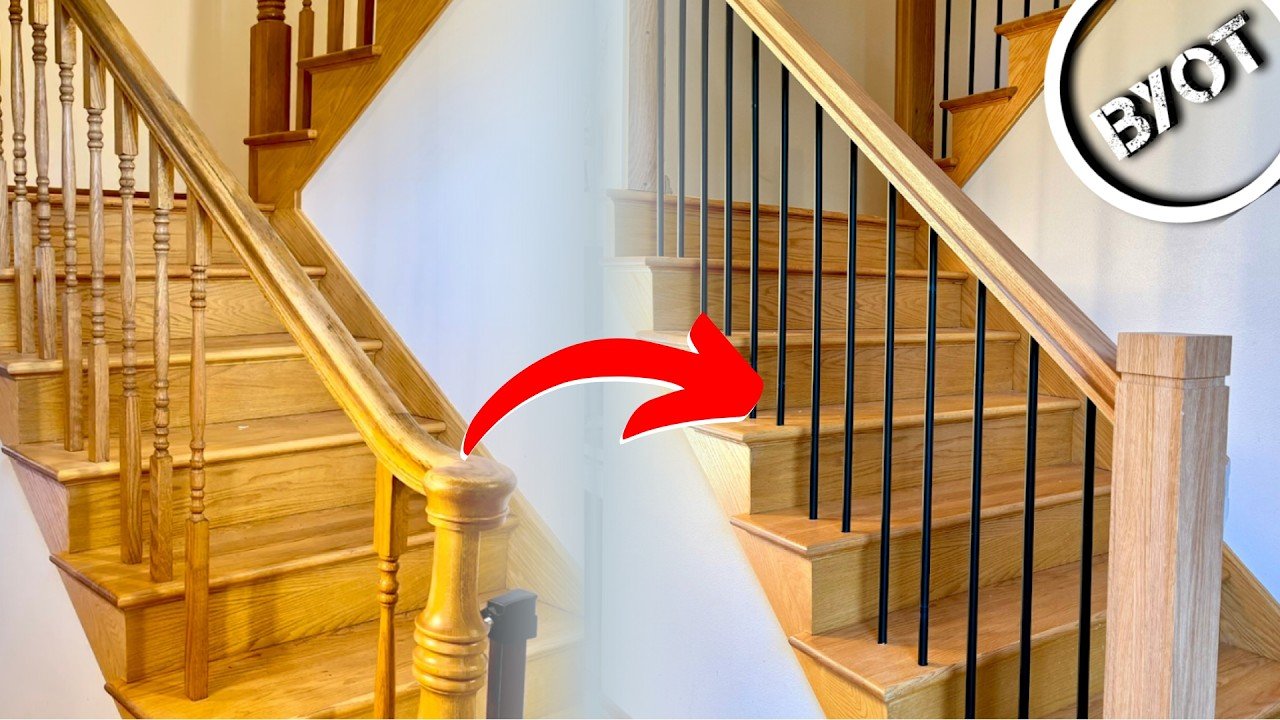
Part 1 of a two-part stair railing remodel replaces an outdated white oak railing with a Stair Supplies system. It covers a wall-to-wall handrail with rosettes, box newels fastened with newel fasteners, half newels, and handrails installed between newels and along the stairwell. The balusters are left for part 2.
Full written account
How do you replace a worn white oak railing with a modern system without rebuilding the staircase? In part one of a two-part remodel, the presenter swaps an outdated railing for a Stair Supplies system, starting with the easiest straight run, a balcony area, before moving to harder stairwell sections.
Starting with a straight run
The original balcony railing was held by two screws on each side, and the core caps had to be drilled out before the screws could be reached. He recommends keeping a straight run intact so it serves as a template for the angle and length. Tape marks the cut line, and he uses a fine finish blade because the cuts need to be accurate.
After talking with Stair Supplies, he chose a rosette on both sides for extra stability and strength and easier installation. The rosette thickness has to be accounted for when cutting the railing. Holes are pre-drilled in the rosettes and screws go through them into the framing. He says to check code for your state or area; in his state the height must be 34 to 38 in. from the floor to the top of the handrail.
Hiding the fasteners
Pre-manufactured plugs generally do not match the finish, so he makes his own from a scrap of the railing. A simple tool cuts plugs to fit the 3/8 in. hole. He sands the sides slightly, matches the grain and taps them in.
Box newels
The box newels come long and are cut down to size, accounting for the existing railing height. For demo he used a reciprocating saw on the old railing, and he says to block off the stairs so no one uses them. The old box newels had been installed before the flooring, so he removed what remained with an oscillating multi-tool and sanded the surface flush.
The newel fastener lets a newel be secure without being framed into the subfloor. It takes a 3/8 in. hole at least 5 1/2 in. deep, then a 5/8 in. bit about an inch down. He calls the large screw a beast to drive and notes that a larger wrench makes it easier. On the post bottom he finds dead center, measures up 5 in., and drills about 2 1/2 in. with a 1 1/2 in. Forstner bit, using a level for the bottom hole. A crescent-shaped washer and nut finish the connection.
He says a misunderstanding between him, the client and the supplier left the posts with a tall accent head, so he cut them down.
Half newels and rail bolts
Where the railing meets a wall, a half newel copies the look of the newel post in a thinner format. Because it is anchored to the wall and rests on the floor, it adds strength. A smaller version of the fastener goes into the original post, and the handrail is joined with a rail bolt kit. He used a 1 1/2 in. Forstner bit where the kit specifies 1 in., for extra room, and recommends a ratcheting combination wrench. A laser level lines the posts up with the baluster holes in the floor.
The stairwell railing
The stairwell railing was face-mounted into the stair riser with a heavy amount of construction adhesive. The new posts are about a half inch thicker, so a small amount of stair nosing and tread had to be cut away with a multi-tool. The new post is cut down 3 in. to match the old height. He used 5 1/2 in. screws plus construction adhesive. Because the rail sits at an angle, the box rail kit could not be used, and he drilled through the top of the handrail and covered it with plugs. The final half newel sits at an awkward spot where the landing meets the wall, so the handrail is notched on both sides to lie flush against the post. The balusters are left for part two.
Questions this video answers
How tall should the railing be?
The presenter says to check local code; in his state the handrail must be 34 to 38 in. above the floor.
Why use rosettes on a wall-to-wall handrail?
He says they add stability and strength and make installation easier, since you can pre-drill and drive screws through them into the framing.
How are the screw holes in the rosettes hidden?
He makes plugs from a scrap piece of the railing to fit the 3/8 in. holes, matches the grain, and taps them in.
How is a box newel fastened without framing it into the subfloor?
With a newel fastener: drill a 3/8 in. hole at least 5 1/2 in. deep, then a 5/8 in. bit about an inch deep, drive in the large screw, and secure the post with a crescent washer and nut.
Why use half newels?
They copy the look of the newel post in a thinner format, and because they are anchored to the wall and rest on the floor they add strength.
Explore related projects
Connected by the topic: Carpentry