Patch a Hammer-Sized Drywall Hole: Cut, Tape, Mud and Texture
The short version
A hole is made in a wall and then repaired start to finish. The damaged area is squared off, a 9 1/4 by 10 in. drywall piece is cut and screwed to scrap backing in the corners, then taped and mudded over two days. A knockdown texture is splattered on and the wall is painted.
Full written account
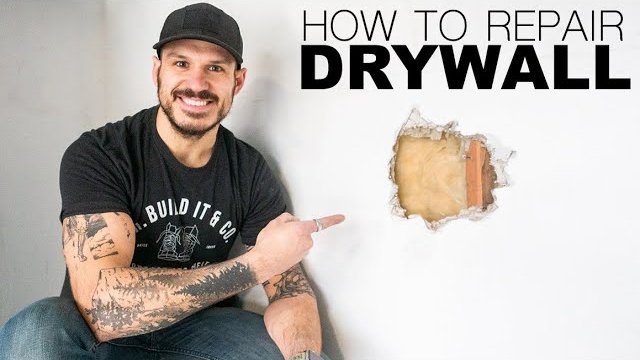
How do you patch a hole in drywall when there is a stud down the middle and nothing on the sides? A demonstration hole, made with a mallet, shows the method from cutting to paint, spread over two days.
Preparing the opening
The first step is to draw a straight, square outline around the damage with a straight edge. A drywall knife cleans out the area. A utility knife could scrape it too, but it is harder; the drywall knife costs about eight dollars.
Ideally the studs would sit at the edges of the opening so the new drywall could be screwed straight into them. Here they are not close enough, so the patch needs reinforcement.
Cutting and fitting the patch
The patch is 9 1/4 by 10 in. To cut it, lay a straight edge on the sheet and score it with a knife. The score only goes about an eighth of an inch deep. Flip the sheet over, snap it, and trim the back paper with the knife.
Scrap pieces of wood, in this case MDF, are screwed into the corners, since the corners are the most important points to connect. Everything must be flat. The patch is then screwed around its edges, with the screws countersunk a little so they do not interfere with the mud and tape.
First day: tape and mud
Supplies are drywall tape (about two dollars), a 6 in. putty knife and all-purpose pre-mixed mud. A layer of mud goes on where the seams are, the tape is pressed into it with the putty knife, and the squeezed-out mud is put back over the tape. Covering the tape with mud gives better adhesion and avoids dry air pockets that could let it peel. It then dries overnight.
Second day: blending and texture
The compound is thinned to a ketchup consistency, running off the blade. A 10 in. blade blends the tape into the surrounding wall, with enough mud to cover the tape but not so much that it builds another layer.
Two common textures are orange peel and knockdown. For orange peel, use a texture product matched to the coarseness. For knockdown, thinned mud is splattered on with a putty knife, then knocked down lightly. The wider the texture is applied, the less likely anyone will see the transition. After paint, the repair is hard to see.
Questions this video answers
What tool cleans out the damaged drywall?
A drywall knife, which he says costs about eight bucks, is used to clean out the damaged area. A utility knife can do it but is harder.
How is the patch secured when there is no stud at the edges?
Because the studs are not close to the edges of the hole, he screws scrap wood (MDF) into the corners behind the patch and countersinks the screws around the new piece.
What do you use for the tape and mud?
Pre-mixed all-purpose mud, drywall tape (about two dollars) and a 6 in. putty knife for the first layer; a 10 in. blade for the second.
How thin should the second coat of mud be?
He thins the compound to about a ketchup consistency so it runs off the blade and blends the tape in.
How is the texture matched?
He splatters thinned mud with a putty knife, then lightly knocks it down, working wider for a better match. For orange peel he uses a texture product.
Explore related projects
Connected by the topic: Drywall