Three Voltage Testers and What Reverse Polarity Does to a Lamp
The short version
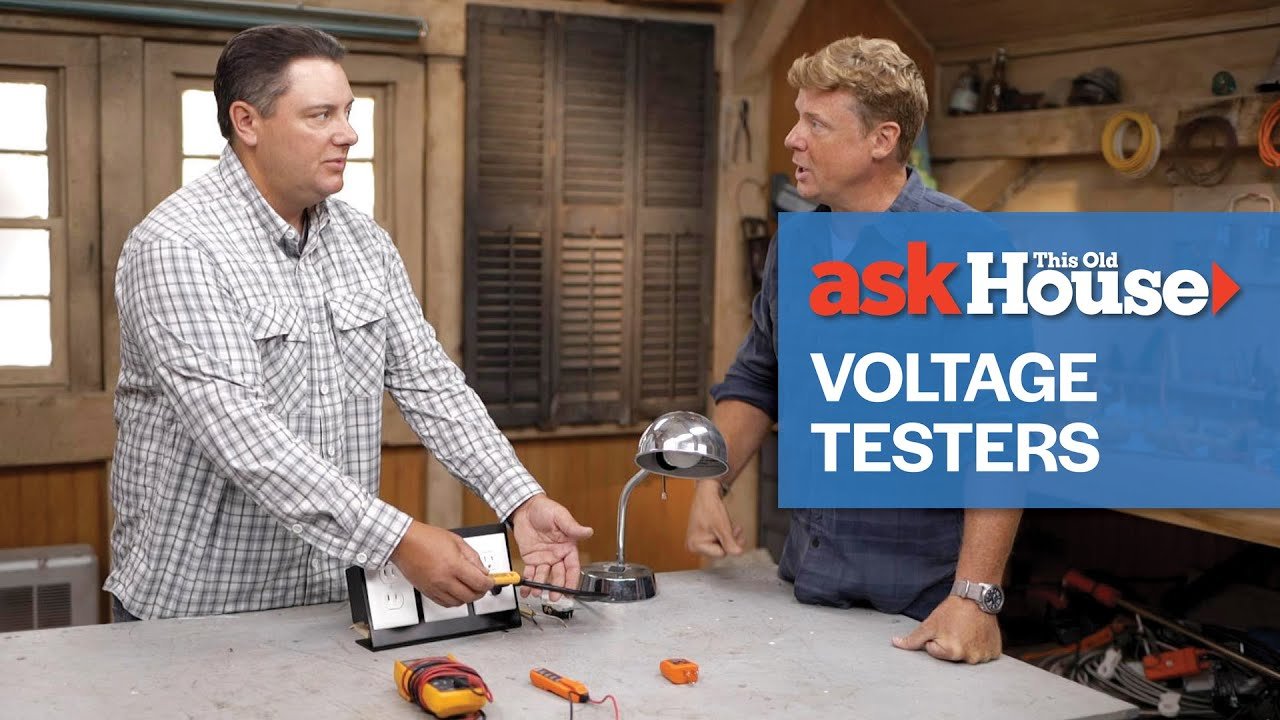
Master electrician Heath Eastman shows Kevin O'Connor three testers: a contactless voltage tester, a simple contact tester that lights 24, 48, 120 and 240 volt levels, and a three-light receptacle tester. He demonstrates how reverse polarity leaves a lamp socket shell energized even with the switch off.
Full written account
Master electrician Heath Eastman walked Ask This Old House host Kevin O'Connor through three testers that show whether something is energized and whether it is wired correctly. Eastman's point is that the tester tells you if a circuit is off before you work on it, or if it is on, whether it is wired properly.
Contactless voltage tester
The first is a contactless voltage tester, which Eastman says is something a homeowner ought to have. Pointed at a receptacle prong, it chirps when something is energized. It does not say how much voltage is present, only that something is energized. It also works on an exposed wire or a cord, for example to check a fan.
Its drawback is phantom readings. Because it is contactless, placing it on the wrong spot may suggest something is not energized when it is. Eastman says to always follow up with a contact tester before working on something.
Contact tester with voltage levels
Eastman's own contact tool is a multimeter that does more than a typical homeowner needs, but a simpler version is still worth having. The simple tester plugs into the outlet and lights up to show the level present: 24, 48, 120 and 240 volts. At the outlet shown, the first three lit, meaning 120 volts but not 240. Because it makes direct contact, it should not give false or phantom readings.
Three-light receptacle tester
The small plug-in tester has three indicators and a grid on its front. It cannot be used on two-prong receptacles, but on three-prong ones it indicates what is going on. A pattern of on, on, off indicated reverse polarity, meaning the black and white wires are reversed on the receptacle.
Proper wiring puts the black wire on the brass screw, the white neutral on the silver screw and the ground on the green screw. A reversed receptacle still works, but Eastman calls it a safety hazard.
Why reverse polarity matters
With a metal desk lamp on the correctly wired receptacle, the tester read correct. On the reversed receptacle the lamp still turned on and off, but with the switch off the socket was still energized. In a socket the center pin should be the hot wire and the shell the neutral. When reversed, the switch turns off the neutral rather than the hot conductor, so power reaches the brass shell, and touching it with the bulb out can zap you. Rewired correctly, turning the switch off de-energizes the center pin and the shell is neutral.
Eastman recommends the three-prong tester in particular, and O'Connor says he will carry all three.
Questions this video answers
Does a contactless voltage tester show the voltage?
No. It only shows whether something is energized, not how much voltage is present.
Why check with a contact tester after a contactless one?
It can give phantom readings, so you could think something is off when it is energized. Follow up with a contact tester before working on it.
What does the three-light outlet tester show?
It shows which lights are lit on a grid; on, on, off indicates reverse polarity, where the black and white wires are reversed on the receptacle.
Why does reverse polarity matter?
A reversed receptacle still works, but the switch turns off the neutral instead of the hot conductor, so the lamp socket shell can stay energized.
Can the three-light tester be used on two-prong outlets?
No. It works on three-prong receptacles; for two-prong outlets, a contactless tester or multimeter-style tester is used.
Explore related projects
Connected by the topic: Electrical