Staircase Makeover: Refinish Railing, Add a Runner Under $400
The short version
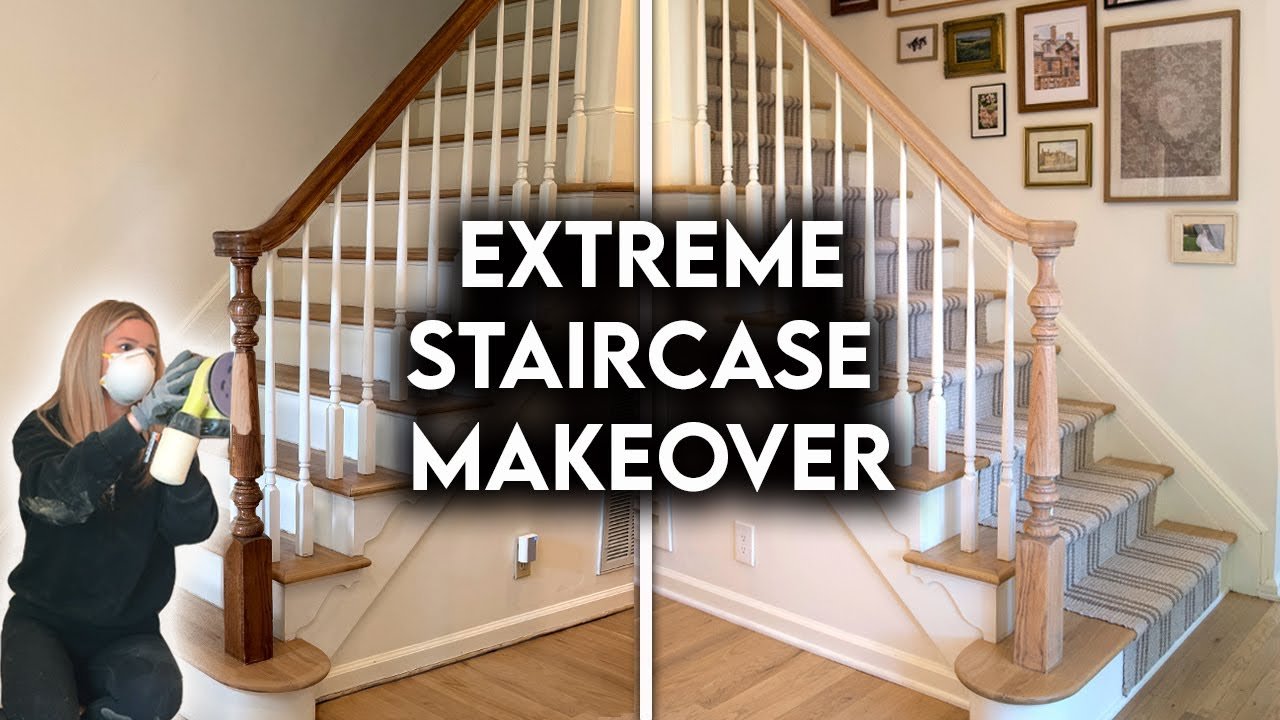
A homeowner refinishes a dark builder-grade staircase railing and newel posts by sanding with 80 and 120 grit and applying a one-coat sunbleached stain to match the white oak floors. She swaps a rattling metal air return vent cover for a paintable one, installs a striped wool stair runner from four 8 ft runners over carpet pad using carpet tape and a narrow crown stapler, and hangs a gallery wall up the stairs.
Full written account
A 1980s builder-grade staircase with a dark wood railing got a budget refresh in a project that combined sanding and staining, a new air return vent cover, a stair runner and a gallery wall. The runner look came in under $400, against about $4,000 quoted for a custom 24 ft runner.
Refinishing the railing and newel posts
The floors had been refinished a year earlier, but the white oak finish never continued up the railing, which was the one wood piece in the entryway that didn't fit. The vent was taped up and small decorative items removed before sanding because of the dust. She had already tested the sanding on the two railings and two newel posts upstairs.
She used an orbital sander with 80 grit sandpaper on larger surfaces to remove stain and varnish, and a cordless Milwaukee detail sander for edges and crevices. A set of hard sanding sponges, wrapped in sandpaper, reached tight corners. She noticed that the house, built in the late 80s, seems to have different woods in the railing, probably pine and poplar, which made a perfectly matching finish difficult. Once the dark stain was off, she switched to 120 grit for a smooth surface.
She chose Verithane sunbleached wood stain, a one-coat stain that should dry in an hour before a top coat. A natural stain she tested made the wood look orange. She applied it with a sponge brush and wiped it off with a cloth, then let it dry overnight before the top coat the next morning.
Replacing the air return vent cover
The old metal cover rattled and looked dirty. The replacement is paintable and has larger slats. To size one, measure the opening from the inside edge to the inside edge. She removed the old filter, which was full of cat hair, and the old frame, popped in the new metal insert frame, and secured it with the existing screws. The new cover was slightly smaller, so she painted around the edges in Sherwin Williams West Highland White and painted the cover to blend with the wall.
Installing the stair runner
The stairs are steeper than usual and slippery, so the runner adds grip and sound absorption. She bought four 8 ft by 2 1/2 ft neutral striped wool runners at $114 each. To find the length needed, add the rise (8 in) to the tread depth (10 1/2 in) and multiply by the 14 steps: just over 23 ft, plus another foot.
Carpet pad went down first, cut from a template piece, extended about an inch to an inch and a half so it wraps under the tread and can be stapled there. Green tape marked the runner's position on every tread, with carpet tape on both sides of the treads and on every riser. She started at the top so the finished edge sits there, then worked from the bottom up and filled the middle with the third rug so all the seams are hidden in the middle. A narrow crown stapler, with a narrower tip and smaller staples than a staple gun, gave a cleaner finish.
The gallery wall
For the wall, she taped out a shape that follows the direction of the stairs, using white oak, dark wood, black and gold frames. Similar frames are spread apart. Vintage digital downloads from Etsy cost about $1 to $3 and were printed at Staples.
Questions this video answers
How much did the stair runner cost?
Each striped wool runner was $114. She ordered four, and the whole look came to under $400.
How do you calculate how much runner you need?
Add the rise to the tread depth, then multiply by the number of steps. Here that was 8 in plus 10 1/2 in across 14 steps, about just over 23 ft, and she added another foot.
What stain and sandpaper were used on the railing?
She sanded with 80 grit to remove the old stain and varnish, then 120 grit for smoothness. She finished with Verithane sunbleached wood stain, a one-coat stain, applied with a sponge brush and wiped off.
Where do you hide the runner seams?
She hid them in the middle of the staircase, tucking one runner under the top lip and cutting at the seam so it can't be seen.
How did she attach the runner?
She used carpet tape to hold placement, then stapled with a narrow crown stapler over carpet pad that wraps about an inch to an inch and a half under each tread.
Explore related projects
Connected by the topic: Carpentry