Shop Vac Dust Collection: Cyclone, Blast Gates and a Remote Switch
The short version
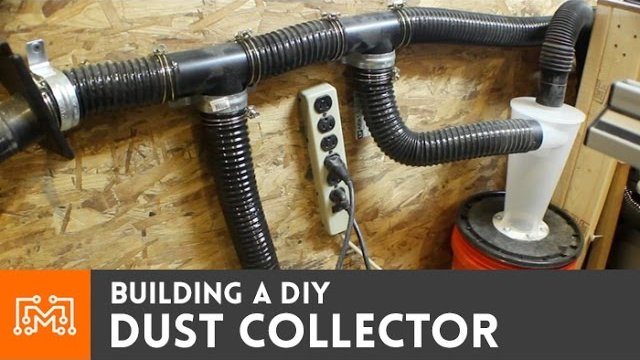
A shop vac dust collection system built around a Dust Deputy cyclone on a 5-gallon bucket, with a main trunk of T fittings and hose, a blast gate at each tool, and MDF floor sweeps. The maker also wires a remote switched receptacle so the shop vac, mounted under a table, can be turned on and off from the workbench. He warns that fittings labelled 2.5 inches may measure from the inside or outside diameter and not fit together.
Full written account
A small woodworking shop with no room for a large collector can run dust collection from a wet/dry vac. In this build, a Dust Deputy cyclone on a 5-gallon bucket with a top catches debris before it reaches the shop vac, and a trunk of T fittings and 2.5 inch hose carries suction to each tool through a blast gate.
The cyclone and bucket
The parts are quarter inch bolts, washers and nuts, blast gates, T's, hose clamps, the Dust Deputy cyclone, a 5-gallon bucket with a top, and hose. The cyclone is set on the bucket top and the hole positions marked so they can be transferred to the lid. Those holes are drilled with a quarter inch bit. Calipers mark a three inch circle from the center of the lid, and a utility knife cuts it out. The hole has to be the right size because it is where the debris falls through.
Gaps should be sealed as far as possible, so caulking goes between the cyclone and the lid before the bolts and washers are tightened. Insulation tape wrapped around the cyclone input builds it up to the right size for a coupling, so the 2.5 inch hose plugs straight in. A test shows how much of the debris goes into the bucket and not into the shop vac.
Trunk, T's and blast gates
A T and some hose form the main trunk from the cyclone. The cyclone is placed where it should work best and connected to the shop vac. Then the position of the main connector on the wall is worked out and the hose cut to length. Brackets mount the T's to the wall, and gravity helps them sit well.
Every tool gets a blast gate so suction can be switched on and off for each tool individually. Each is connected with hose and a hose clamp to the trunk. Blast gates can't sit as close to the wall as the T's, so the brackets hold them in place, but they won't sit flush. All gates should be closed except the one in use.
Floor sweeps
Two sweeps for the floor are made from MDF, a couple of strips and a triangle. The blast gate circle is traced on the top of the sweep. A Forstner bit drills a pilot hole to remove as much material as possible in one pass, brad nails hold the pieces together, and a jigsaw cuts out the rest of the circle. It fit perfectly on the first try.
Remote switch
The shop vac is mounted under a table, so a remote receptacle with a switch is wired in the middle of the shop. On the receptacle, white goes with the silver screws, black with the gold screws, and green is always ground. The receptacle is mallet-fitted into a remodel box. On the switch, the two white wires are tied together, the two blacks go to the gold screws, and the two grounds go to the green screw. The result is described as an extension cord with a switch in the middle. The switch is mounted on the end of the workbench and secured with zip-ties so it doesn't snag.
Fitting sizes
Fittings that all say 2.5 inches may be measured by inside diameter or outside diameter, so two pieces may not fit even though they are the same size. Extra hose and hose clamps allow short sections to be cut to join pieces that won't otherwise fit.
Questions this video answers
What does the system use to collect dust?
A Dust Deputy cyclone on a 5-gallon bucket with a top, connected to a shop vac.
How does the suction go to each tool?
A main trunk of T's and hose runs from the cyclone, and each tool or sweep connects to it through a blast gate.
Which blast gates should be open?
Keep all of them closed except the one for the tool being used.
Why make a remote receptacle?
The shop vac is mounted under a table and hard to reach, so a switch at the workbench turns it on and off.
What fitting problem can come up?
Parts that all say 2.5 inches may be measured by inside or outside diameter and not fit; extra hose and hose clamps let you bridge them.
Explore related projects
Connected by the topic: Electrical