One 2 HP Collector, Whole Shop: 6 in. PVC Dust Collection Setup
The short version
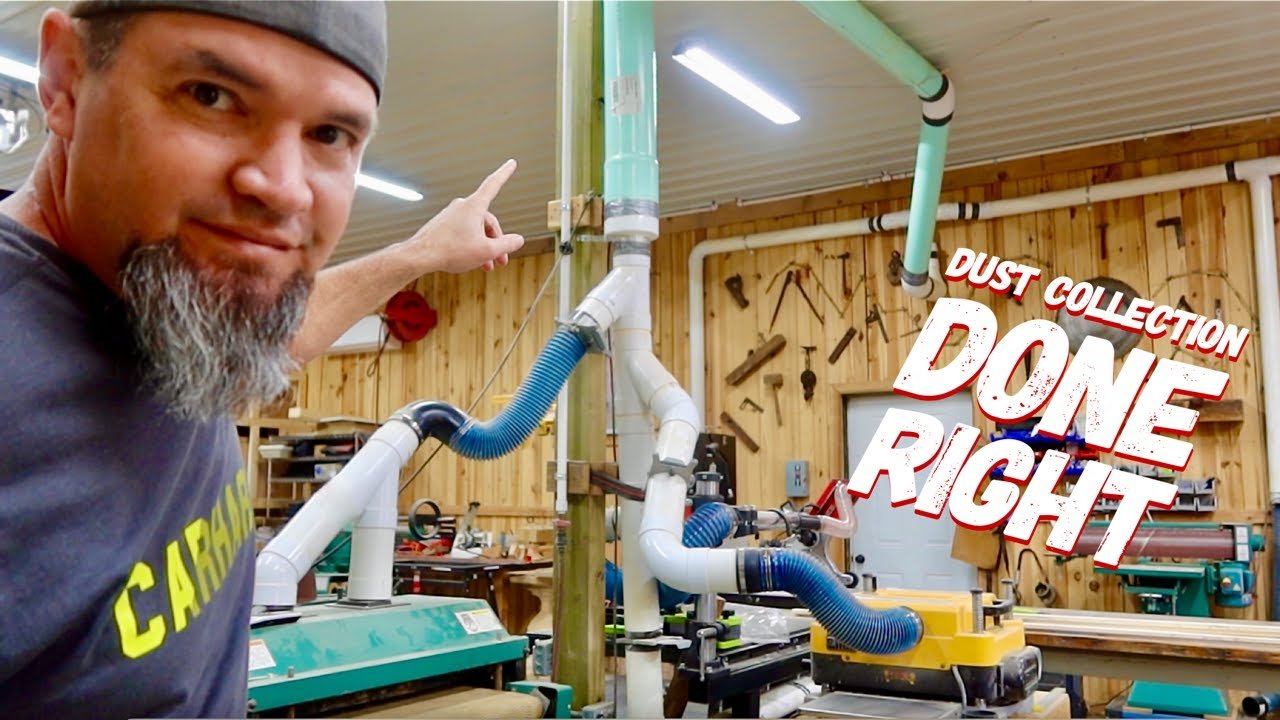
A woodworker walks through his overhead dust collection system that runs a whole shop from one 2 hp, 220V collector. The trunk line is 6 in. PVC with 4 in. drops, and the video covers fitting choices, blast gate orientation, and not gluing the PVC. It ends with suction tests on several machines, including a run of about 50 feet and a planer.
Full written account
Matthew Peech runs an entire woodworking shop off a single two horsepower, 220V dust collector, with some runs of about 50 feet. The collector sits on a platform built above the shop, with a straight shot into the room, and he wired a switch so he can start it from outside that room.
The trunk line and the collector
The trunk line is 6 in. sewer-grade PVC, reduced to 4 in. at the drops to the machines. The collector ships with a splitter that divides its 6 in. port into 4 in. ports. He says that splits the CFM in half from the start, so he removed it and connected the trunk line directly. He attributes the 4 in. ports to industrial equipment standards that dust collector makers followed.
The outfeed is a 4 in. line that runs outside. His reasoning is that anything between the outfeed and the outdoors, such as a filter bag or cyclone, creates resistance. He notes that people in cities with close neighbors or ordinances may not be able to do this.
Layout decisions
He kept his central grouping of tools close to the trunk line, with the main bank only about 15 feet from the collector. Reducing pipe size in a drop reduces CFM, so the machines needing the most suction are nearest the collector. He puts typical requirements at 350 to 400 CFM for most equipment, with planers, shapers and jointers needing more. A Rockler adapter lets one drop serve both the jointer and a sander on a mobile base, since every drop decreases suction.
He uses 45s wherever possible, since any 90 or 45 fitting reduces suction. Where a 90 is needed he uses a sweeping or long one. Each branch uses a Y connector angled in the direction of flow, and each tool has its own blast gate. Because he usually runs one machine at a time, he opens one gate and keeps full suction.
Mistakes to avoid
- Blast gate direction: with a metal gate the knob should be at the bottom. Tightening it then pushes the plate up to seal. Installed the other way, it pushes the plate down and creates an air gap.
- Gluing PVC: he did not glue it. He says the fittings create their own vacuum and pull together, and he taped major joints with thick Gorilla-style tape. Leaving it unglued means he can move or extend it, and he plans to replace the current planer with a 20 in. planer with two 6 in. ports.
- Adapters: standard PVC does not match dust collection pipe, flex hose or blast gates, so he recommends buying plenty of the Rockler adapters. He ran out and made a gasket by wrapping 1 in. Gorilla tape once or twice around the inside of a blast gate base, and says he found no leaks.
- Planning: he advises drawing everything out, measuring the furthest run and using online calculators that account for CFM and static drag.
The miter saw problem
The miter saw sits on his longest run, which he puts at probably 50 feet, and he is not happy with it. The saw throws dust around and its RPM exceeds what the collector can pull, and the run reduces from a 4 in. pipe to a flex hose of 1.5 or 2 in. He built that section as temporary, until he builds a miter saw station with a downdraft box.
Suction tests
He tests a drop right off the trunk line, then the drum sander, then a shaver, which he says needs among the most CFM. Even on a 4 in. flex line it performs well, and he does not believe an all-4 in. system would give the same results. The longest run, reduced to about 2 in., still handles the dust, and the system then handles the thick shavings from his 12 in. planer.
Questions this video answers
What size pipe does he use?
A 6 in. sewer-grade PVC trunk line with 4 in. drops to the machines.
Should the PVC be glued?
No. He says the fittings pull themselves together under vacuum, and he taped major joints with heavy tape so the system can be changed later.
How should a metal blast gate be installed?
With the knob on the bottom, so tightening it pushes the plate up and seals. Reversed, it pushes the plate down and creates an air gap.
Which tool is the weak point?
The miter saw, at the end of his longest run of about 50 feet, reduced to a 1.5 or 2 in. flex hose. He plans a miter saw station with a downdraft box.
Where does the collector exhaust go?
Through a 4 in. line to the outside, with no bag, filter or cyclone, to reduce resistance.
Explore related projects
Connected by the topic: Woodworking