How to Install a Stair Railing: Newels, Balusters and Handrail
The short version
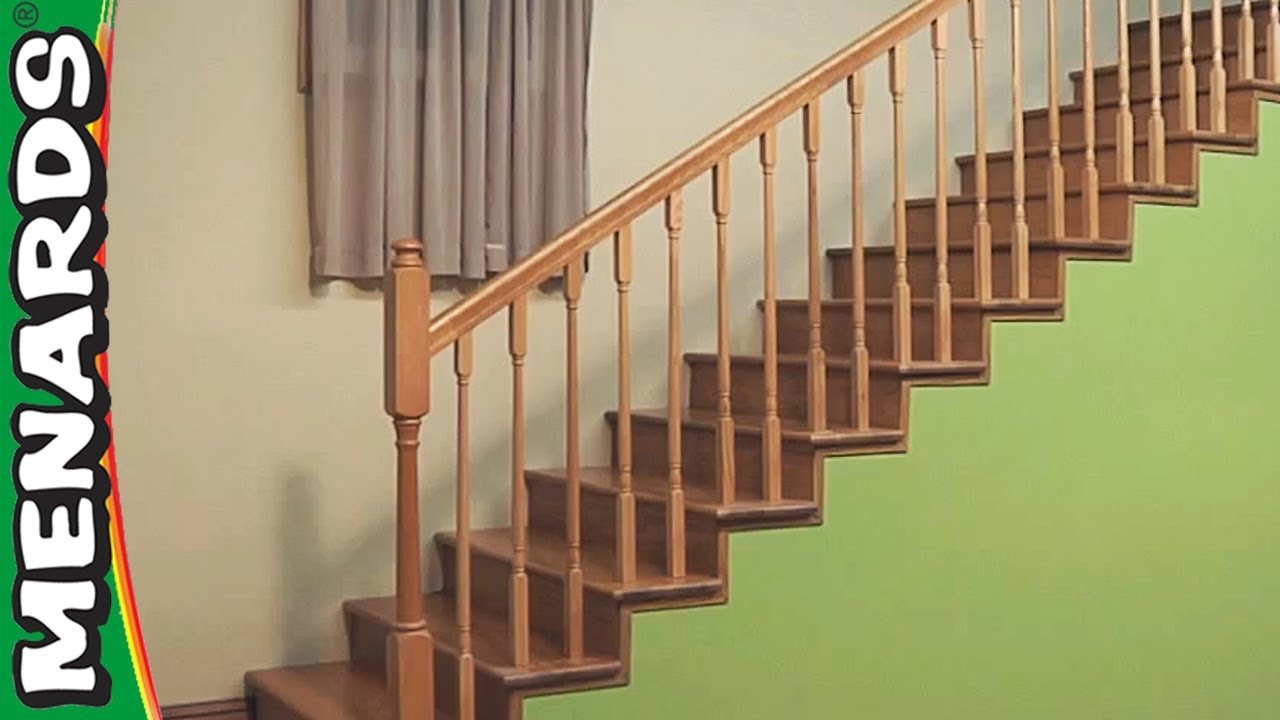
A Menards Around The House episode with Scott Feroni of Colonial Elegance shows how to install a stair railing. It covers estimating railing length, setting the half-newel and bottom newel, drilling 3/4 in. baluster holes in the treads, attaching the handrail with a rail fastener, and cutting and gluing balusters and fillet pieces. The railing should set 24 hours for the glue to dry.
Full written account
Installing a stair railing starts with a count: for most residential staircases, each step counts as one foot, plus an extra foot. Scott Feroni of Colonial Elegance, speaking with host Jake on Menards' Around The House, gives the example of 12 steps needing at least 13 feet of railing.
Planning the parts
The staircase needs a newel post at the bottom, another newel post for each turn or landing, and a half-newel where the railing meets the wall. Each step takes one short baluster for the front and one long baluster for the rear. Straight sections should be measured too. If the old stair treads are worn, the video suggests replacing them at this point.
Half-newel and handrail height
Pilot holes are drilled in the half newel, which is anchored to the wall studs with three inch construction screws. The bottom screw is covered with a plug and the top screw is hidden by the handrail.
Handrail height depends on the baluster length:
- 36 inch balusters: center of the handrail 35 and a half inches above the floor.
- 39 and a half inch balusters: center of the handrail at 39 inches.
A few inches may need to be trimmed from the bottom of the half newel and newel posts so the handrail sits roughly in the center of the flat section. In this installation, 5 and a half inches were trimmed.
Bottom newel and baluster holes
For the bottom newel, the three inch post width plus half its width gives 4 and a half inches. That distance is measured from the front of the step and from the side to find the post center. After a pilot hole is drilled, a double-ended lag bolt is screwed into the bottom of the newel and then into the stair, with the post checked for level.
The handrail section is laid on the treads and both ends are marked at the angle where they meet the posts, then cut. Three-quarter inch holes are drilled in each tread for the balusters, 3 and one-sixteenth inches from the front and back edges, which gives a 4-inch space between balusters. The video advises checking local building codes to confirm the spacing meets requirements.
Handrail and balusters
The bottom of the handrail is measured up 31 and three-quarter inches from the stair for 36 inch balusters, or 35 and a quarter inches for 39 and a half inch balusters. A rail fastener joins the handrail to the bottom newel: a pilot hole is drilled in the post at the handrail's angle, the bolt is installed, and the handrail gets a pilot hole for the bolt and a larger hole for the nut. Glue is applied, the rail slides onto the bolt, and the nut is tightened. The top of the handrail is attached with finishing nails.
Each baluster is set in its step hole and marked along the bottom edge of the handrail for the top cut. It is cut a sixteenth of an inch longer to fit the groove in the underside of the handrail. After checking for level, balusters are glued and nailed. Fillet pieces that fit under the handrail between the balusters are cut and secured.
Straight sections follow the same order: cut the handrail, install bolts into the newels, set the balusters and install the handrail. Excess glue is cleaned up, and the railing sets for 24 hours.
Questions this video answers
How much railing do I need?
Count each step as one foot, then add an extra foot. For 12 steps, buy at least 13 feet of railing.
How high should the handrail be?
For 36 inch balusters, the center of the handrail goes 35 1/2 inches above the floor. For 39 1/2 inch balusters, it is 39 inches.
How far apart are the balusters?
In this installation the holes are 3 1/16 inches from the front and back edges of the step, giving a 4-inch space between balusters. Check local building codes for spacing requirements.
How long does the glue take to set?
The railing should be allowed to set for 24 hours.
What holds the bottom newel post in place?
A double-ended lag bolt screwed into the bottom of the newel and then into the stair.
Explore related projects
Connected by the topic: Carpentry