Finding Studs: Tap, Drill, Magnet or Electronic Stud Finder
The short version
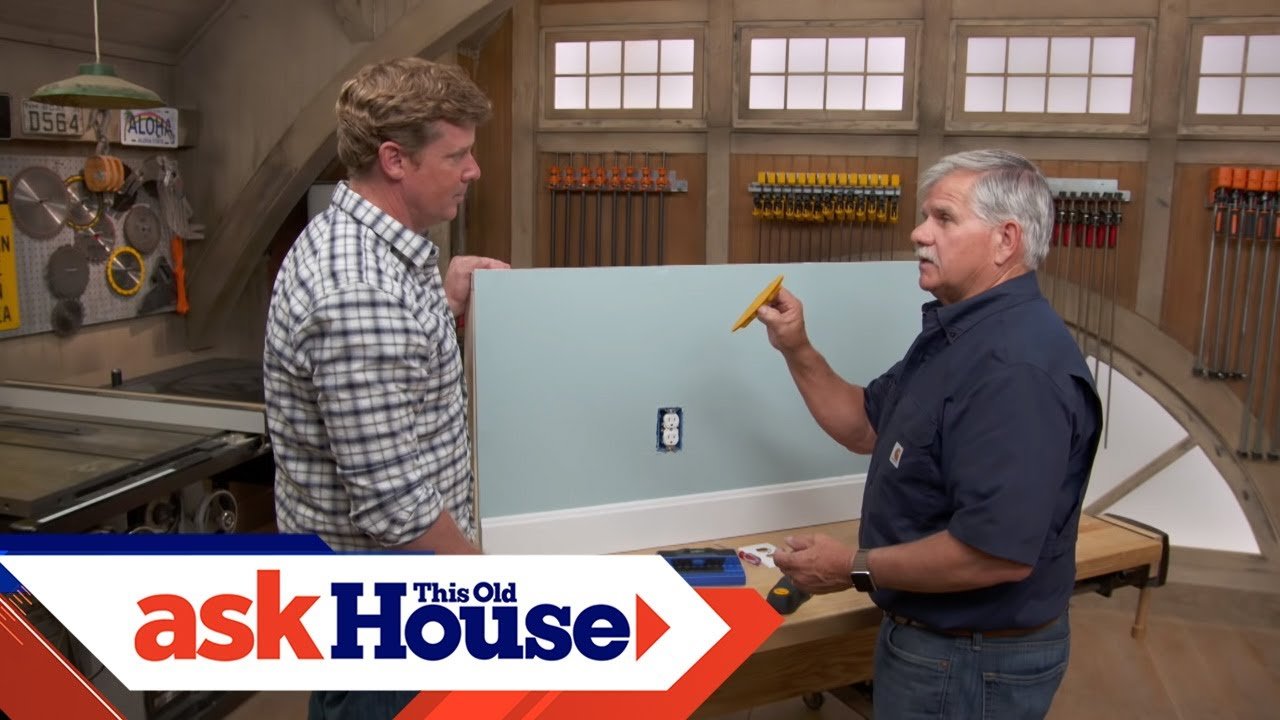
Tom Silva of Ask This Old House shows ways to locate studs: tapping by sound and feel, checking trim for nail holes and drilling, and using an outlet box. He then compares a magnet, a stud finder that measures the wall, and one with a built-in level that shows stud thickness.
Full written account
Hanging a valuable picture or a flat screen TV means knowing where the studs are. On Ask This Old House, general contractor Tom Silva demonstrates several ways to find them, from a trained knuckle to store-bought finders in the $5-50 range.
Sound and feel
Silva taps on the wall and listens. The pitch moves from a low, hollow sound to something a little higher where a stud sits behind the surface. He says this works on a wall built in the late 60s or 70s and newer, which means drywall.
Plaster and lath
In a house from the mid to late 1800s the wall could be plaster and lath, where sound and feel are harder to read. His approach is to look on the baseboard, trim, crown molding or chair rail for signs of a filled nail hole. He drills a small bit close to the molding so there is no hole left in the wall. If the bit hits structure, it's a stud; if it misses, it goes right into the wall with nothing there. The reasoning is that the trim carpenter knew where the studs were and aimed for them.
Using an outlet box
Another way is to take the wall plate off an electrical outlet, after making sure the circuit is off. Electricians usually nail the box to one side of a stud before the drywall goes up, so tapping a screwdriver in right beside the box finds the stud. From there, a tape measure gives the rest: usually 16 on center in an older house, with some newer houses at 24 on center.
Stud finders
- Magnet: run it over the wall and it picks up the metal of the drywall screws. Move it up and down relatively close, because moving only across could pass between two screws.
- Wall-measuring finder: push the button, settle it in, and drag it slowly across the wall. It shows the stud and its center, which you mark.
- Multi-setting finders: some also find electrical wire or a small pipe, things you don't want to hit.
- Finder with a level: line it up, turn it on and drag it across. It shows where the stud is and its thickness, here the center of a two by four.
Questions this video answers
How does Tom Silva find studs without a stud finder?
He taps on the wall and listens for the pitch to change from a low, hollow sound to a slightly higher one.
How do you find studs in a plaster and lath wall?
He looks at the baseboard, trim, crown molding or chair rail for filled nail holes, then drills a small hole close to the molding. If the bit meets structure, it's a stud; if it goes into the wall with nothing there, it's a miss.
How can an outlet box help locate a stud?
Make sure the circuit is off and take the wall plate off. Boxes are usually nailed to one side of a stud, so a screwdriver tapped in beside the box finds it.
How far apart are studs?
Usually 16 inches on center in an older house; some newer houses are 24 inches on center.
How does a magnetic stud finder work?
A magnet picks up the metal of drywall screws. Drag it up and down fairly close, since moving only across could pass between two screws.
Explore related projects
Connected by the topic: Carpentry