Attic Insulation: Cellulose, Fiberglass Batts and a Raised Platform
The short version
This Old House general contractor Tom Silva adds insulation to an attic that had only about two inches of settled rock wool. He rakes loose cellulose level over the joists, then lays un-faced fiberglass batts across the joists. He also frames a raised 2×10 platform with OSB for storage, with rigid foam over the subfloor as a walkway.
Full written account
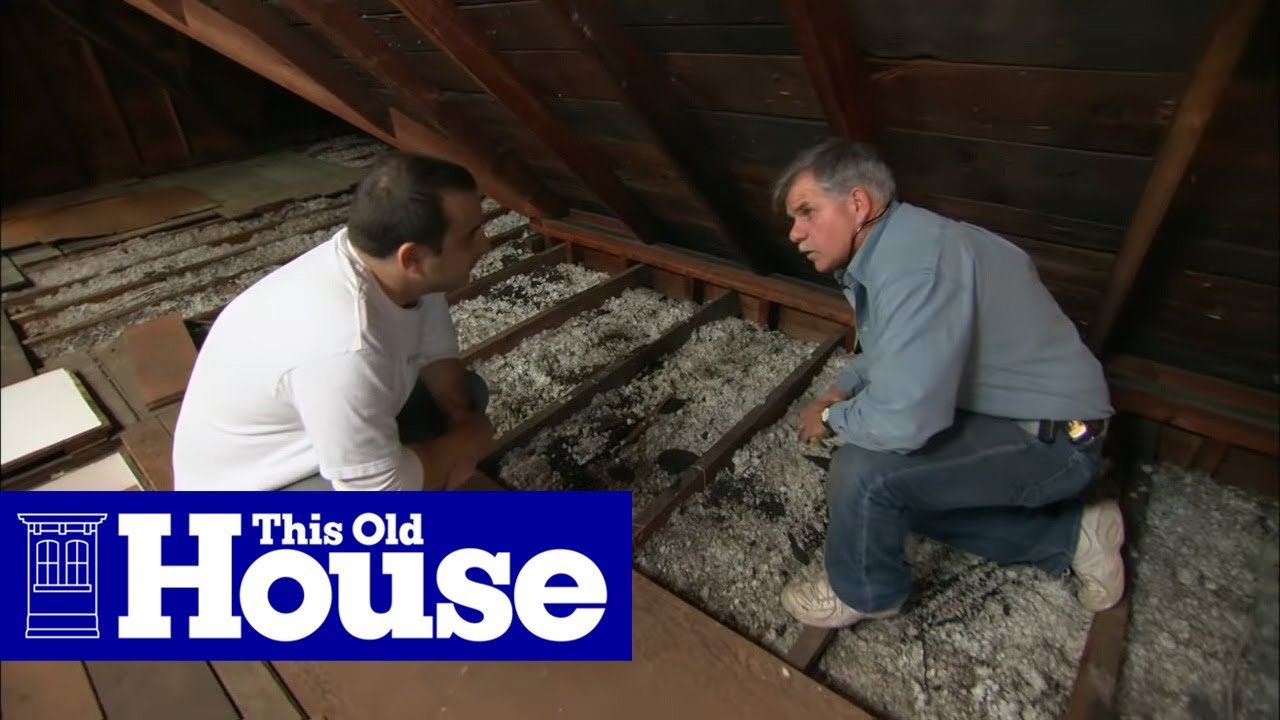
This Old House general contractor Tom Silva helped a homeowner named Tony, who had lived in his house for eight months and noticed it getting cold, add insulation to the attic. The attic held only about two inches of insulation, and Silva's fix used two layers of different insulation plus a raised platform for storage.
What was in the attic
The existing material was rock wool, probably blown in when the house was built years earlier. Like a lot of blown insulation, it settles over time. Only about two inches remained between the joists.
Cellulose first
Silva's first step was to dump cellulose insulation from a bag bought at the home center into the joist bays. Cellulose is sometimes blown in with a machine, but here it was poured and raked level with a leaf rake, kept a little higher than the top of the joists. The result measured six inches, about R19. The video says the building code requires R38, so more was needed.
Fiberglass batts across the joists
The second layer was fiberglass batts, 9.5 inches thick, 24 inches wide and four feet long, laid over the level cellulose. They had no paper facing. The paper is a vapor barrier, and between two layers of insulation it would trap moisture, leaving the lower insulation wet and useless.
The batts ran perpendicular to the joists, fitted tightly. To cut one, Silva used an insulation knife, which is thin and sharp on one edge. He marked 36 inches with the knife, which is two inches longer than the gap so the piece fits snugly. He then pressed down with his hand and dragged the knife across. Gaps between batts are air leaks, so he used the cutoff piece to start the next row.
In the center of the attic floor there was a subfloor with rock wool underneath. Rather than pull up the boards, Silva simply covered them with batts.
A platform for storage
Insulation that has things set on it is compressed and will not be effective. To give Tony somewhere to store items, Silva framed a platform from 2x10s spaced 24 inches apart. Insulation goes between the 2x10s, and the 2x10s and insulation are covered with 7/16 in. oriented strand board.
To reach the platform without walking on fiberglass, Silva laid two-inch rigid foam insulation over the subfloor as a walkway.
Questions this video answers
How much insulation did the attic have to start?
About two inches of rock wool, which the video says was probably blown in when the house was built and settled over time.
What R-value did the cellulose reach, and what does code require?
Six inches of cellulose, about R19. The video says the building code requires R38.
Why use un-faced fiberglass batts over the cellulose?
The paper facing is a vapor barrier. Placed over existing insulation it can trap moisture between the layers and make the lower insulation wet and useless.
Which way do the batts run?
Perpendicular to the joists, fitted tightly with no gaps between batts, since gaps are air leaks.
Can you store things on top of attic insulation?
Not directly. Compressing insulation makes it ineffective, so the video builds a raised 2×10 platform covered with 7/16 in. OSB.
Explore related projects
Connected by the topic: Insulation