Anchoring to Concrete: Titan HD Anchors and a Rotary Hammer Drill
The short version
Scott of Everyday Home Repairs explains how to anchor into concrete without failures, using a solar tracker base with 16 anchor holes as the demo. He compares wedge anchors, Tapcons and Simpson Strong-Tie Titan HD anchors, recommends a rotary hammer drill over a combination drill's hammer setting, and stresses vacuuming debris from each hole before driving the anchor with an impact driver.
Full written account
Scott of Everyday Home Repairs drilled 16 holes in concrete to anchor two brackets for a solar tracker base, and says the job went without a single blowout. His point: most anchoring failures come from the wrong tool, the wrong process and a generic wedge anchor.
Choosing the anchor
In a past poll, thousands of viewers chose among three options: one in 10 picked the Simpson Strong-Tie Titan series, two in 10 used wedge anchors and seven in 10 used Tapcons.
He considers wedge anchors the most likely to fail. A collar goes into the drilled hole and the anchor is tapped in; threads can get gummed up if they run to the end, so he suggests leaving the nut a little proud when hammering. Tightening pushes the wedge out against the insert, which secures it in the hole. He calls these prone to failure, especially for DIYers.
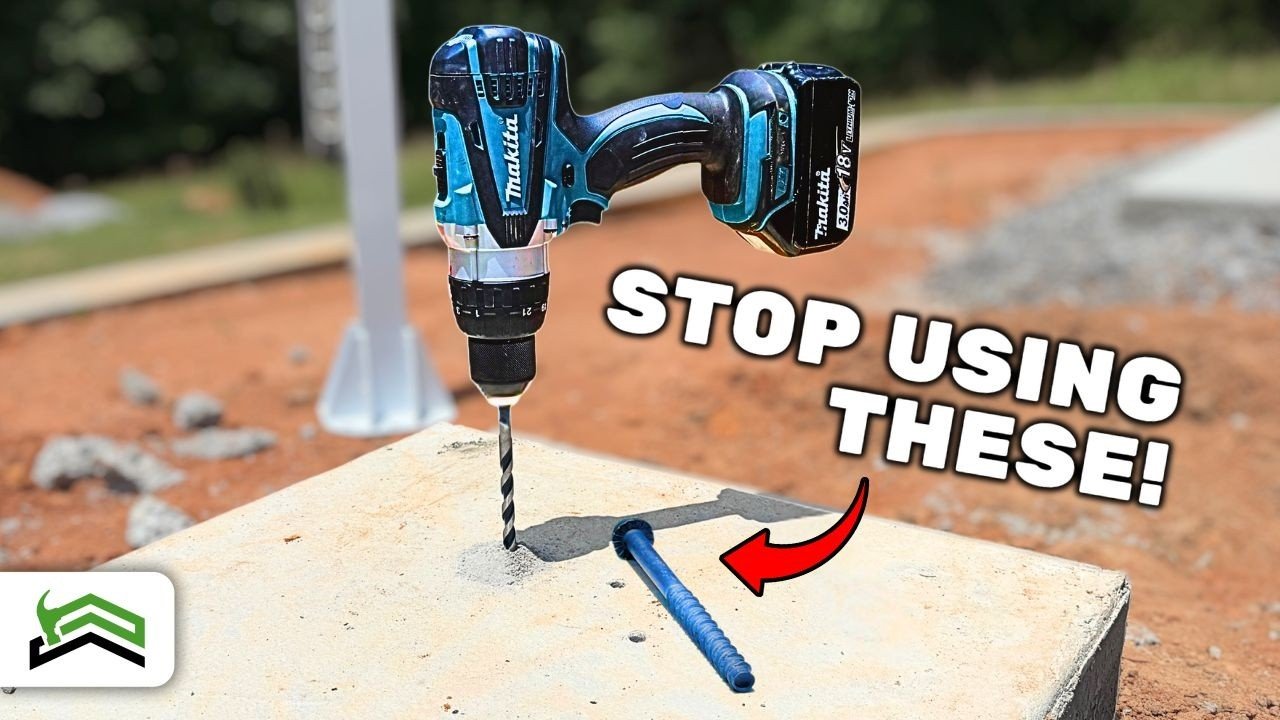
Tapcons have worked well for him, but he has upgraded to the Titan series. He is unsure whether the thread design is the reason, compared with the waves on a Tapcon's first few threads, but says it bites better and has not blown out. Tapcons have blown out for him in the past, which he attributes usually to how the holes were drilled.
Drilling the hole
He calls drilling the most common source of error. Many homeowners default to the hammer setting on a combination drill with the right bit. He says this is not very effective: fine for one or two holes, but with 16 he recommends stepping up to a rotary hammer drill.
In a side-by-side test he drilled a 3/8 in. hole, marking the bit with a Sharpie one inch past the depth needed. The standard hammer drill took two minutes. The rotary hammer drill took 30 seconds, which he calls four times faster. He notes the mark should be measured to the concrete, not the top of the debris pile.
Cleaning the hole
Leaving debris in the hole will probably cause a failure, he says. After drilling about an inch past the fastener depth, he keeps the bit turning in the same direction while a vacuum sucks up the debris pile, then continues vacuuming as he pulls the bit out.
Driving the anchors
Titan HD anchors then go in quickly with an impact driver. His camera overheated, so not all eight anchors on one bracket were filmed, but he did two brackets and all 16 anchors went in secure. He says a rotary hammer drill can be rented.
Questions this video answers
Which anchor does the presenter prefer?
Simpson Strong-Tie Titan HD anchors, which he says bite better and have not blown out for him.
Why do holes and anchors fail?
He says the most common error is how the hole is drilled and what drill is used; leaving debris in the hole will probably cause a failure.
How much faster is a rotary hammer drill?
In his comparison of a 3/8 in. hole, a standard hammer drill took two minutes and the rotary hammer drill 30 seconds, which he calls four times faster.
Do I have to buy a rotary hammer drill?
No, he says you can rent one.
How deep should I drill?
About one inch past the fastener's depth, marked on the bit with a Sharpie.
Explore related projects
Connected by the topic: Carpentry