Gutter Leaking Behind It? Drip Edge, Overhang and Pitch Explained
The short version
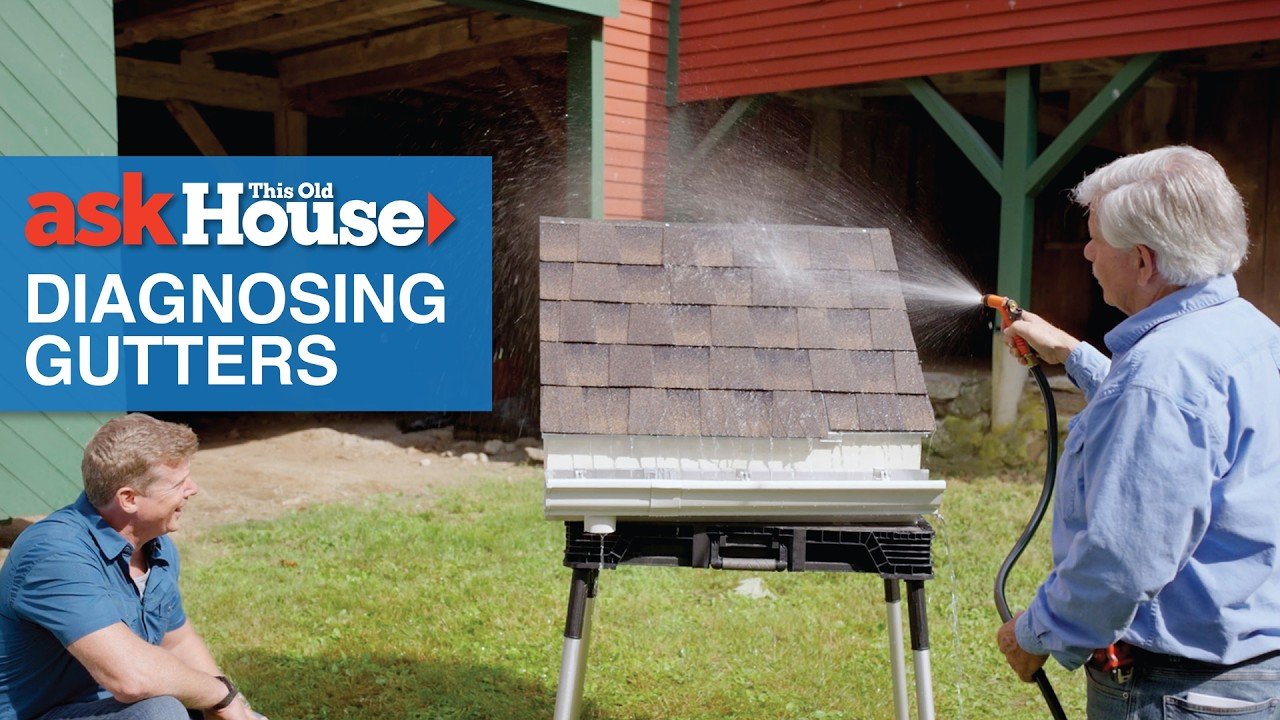
General contractor Tom Silva shows host Kevin O'Connor why water can run between the house and the gutter. He compares a correctly installed roof edge and gutter with an incorrect one, covering gutter height, pitch, drip edge position and shingle overhang. A hose demonstration shows water dropping into the gutter on the proper side and sticking to the shingles and drip edge on the other, running behind the gutter.
Full written account
Water slipping into the seam between a house and its gutter was the problem Jenn brought to Tom Silva and Kevin O'Connor on Ask This Old House. A leaking gutter, as the description puts it, isn't necessarily an old gutter: the cause may be how it was installed or how the roof directs water into it. Tom's explanation centers on surface tension and the adhesion of water.
Gutter height and pitch
Tom first notes the gutter in the example is probably too high on the face, but says that is not what sends water behind it. Laid flat on the roof, a tape measure should run parallel and pass the gutter's leading edge. In climates with ice and snow melt, that placement lets it run off without ripping the gutter away.
On the low end, the space at the edge is about 1/2 to 3/4 of an inch. Pitch should be 1/4 inch for every four feet toward the outlet. On a 40-foot house, the crown goes in the middle at 20 feet, leaving the low end about an inch and a quarter lower than the high end.
Overhang and drip edge
The roof overhang in the example is an inch and a half. Tom wants 1 1/2 to 1 3/4 inches, or even 2 inches. The drip edge should sit away from the fascia board by about the thickness of his fingers, and the shingle starter strip and shingle should extend another quarter to half an inch beyond the drip edge.
Tom says roofers often resist this. The common installation puts the drip edge tight to the fascia with no shingle overhang. In heavy rain, the bubble of water is thicker than the small space left, so the water sticks to the fascia board and runs down behind the gutter, even though the drip edge has a built-in kicker.
The hose test
Tom ran a hose over two sections of roof. On the properly installed side, water was kicked out, did not touch the fascia, and dropped into the center of the gutter. On the other side, the water clung to the shingles and the drip edge and ran in behind the gutter.
The failure is intermittent. Tom says that when it rains, 90% of the time it is windy and blowing, which pushes water toward the house. He calls getting it right very important.
Questions this video answers
Why does water run behind the gutter?
Tom Silva explains that with the drip edge tight to the fascia and no shingle overhang, water sticks to the fascia board by surface tension and runs down behind the gutter.
How much pitch should a gutter have?
1/4 inch for every four feet. For a 40-foot house, the crown goes in the middle and the low end sits about an inch and a quarter lower.
How far should the roof edge overhang?
The edge of the roof should be out 1 1/2 to 2 inches.
How far should shingles extend past the drip edge?
The starter strip and shingle should be another 1/4 to 1/2 inch further out than the drip edge.
Does the leak happen every time it rains?
No. It can be intermittent, and Tom says it is most likely in wind-blown rain that pushes water against the house.
Explore related projects
Connected by the topic: Carpentry