Wiring a Second Basement Light Switch with 14/3 Cable
The short version
A master electrician helps a homeowner whose basement lights are all on pull chains, with one switch at the top of the stairs controlling only the bottom light. He moves a wire so the switch controls every light, then replaces the 14/2 cable with 14/3, adds a new 14/2 run and a second switch so the storage area and the gym area are controlled separately. Power is turned off at the breaker and found with a circuit breaker tracer, and the result is tested at the end.
Full written account
Crystal's basement had one switch at the top of the stairs, and it turned on only the light at the bottom. Everything else, including the storage area and a gaming section, needed a pull chain, so she was walking into the dark. Master electrician Heath Eastman came to rewire it, and the job ended with two switches controlling separate parts of the basement.
Finding the circuit
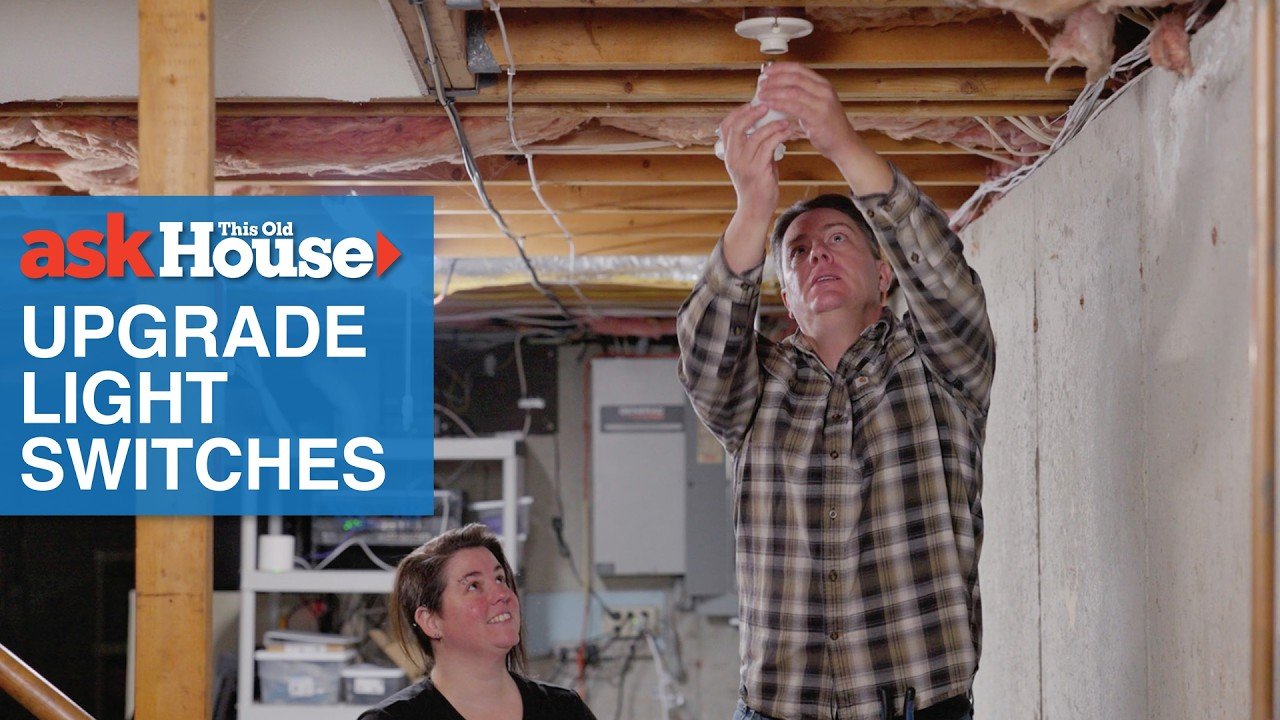
Heath's first step was to turn off the power. He took the bulb out of the first fixture and threaded in a circuit breaker tracer. At the panel, he explained, the tracer goes around the breakers once to get used to the panel, then finds the right breaker on the second pass. The light went off, and the rest of the lights were off too.
How the circuit was wired
Inside the fixture box he found power coming in from the panel to this light, then carrying on to the other basement fixtures, which is why they ran on pull chains. A separate cable went up to the switch: power travelled up on the white conductor, and came back down on the black wire to the fixture.
The first fix
The fix was to move the one wire from the wire nut that went to the other lights and attach it to the terminal on the light at the bottom of the stairs. He then tied the two remaining wires together with the wire nut. With the breaker back on, one switch ran all the lights. Crystal found them very bright and suggested splitting the basement in half, storage on one side and gaming and workout on the other.
Adding a second switch
Heath turned the breaker off again and took apart the switch. To light the two areas separately, he replaced the 14/2 cable from the bottom-stairs light to the switch with 14/3. The extra conductor gives constant power at the switch box while still sending switched power down to the storage-area lights. He also added a new 14/2 from the switch box to the back lights that serve the gym.
For the two-gang old work box, he scored the plaster before sawing, to keep it from chipping. He pushed the saw in, pulled it back slightly and then out, so it cut only on the stroke in. The old wire, loose and fished in the wall, was cut at the bottom and used as a pull for the two new cables.
Splicing the new box
Heath did not trust the stamp on the first box, so he switched to one with its ratings visible and enough room for the added wires. He joined the grounds together, then the neutrals. One pair of wires was the feed from the panel, which now goes up to the switches, and a red wire coming down switches the storage-area lights. The old wire running over to the gym was left in place, separated and capped in the back of the box, so the setup could be swapped back later.
With the bulb in and the breaker on, the gym lights and then the storage area came on from their own switches. The fixtures with pull chains that were not replaced no longer need the chains.
Questions this video answers
How did the electrician make all the basement lights work from one switch?
He moved the wire that went to the other basement lights from the wire nut onto the terminal of the light fixture at the bottom of the stairs.
How were two separate light zones created?
He replaced the 14/2 cable running to the switch with 14/3 for constant power at the switch box plus switched power to the storage lights, and added a new 14/2 from the switch box to the gym lights, with a second switch in a two-gang box.
How did he find the right breaker?
He screwed a circuit breaker tracer into the light socket, went around the panel once, then it found the correct breaker on the second pass.
How did he avoid chipping the plaster when cutting in the box?
He scored the outline first, then pushed the saw in and cut only on the push stroke.
What happened to the old wire to the gym?
He left it in place, separated and capped it in the back of the box in case the homeowners change their minds.
Explore related projects
Connected by the topic: Electrical