Swapping a Light Fixture for a Ceiling Fan on Old BX Wiring
The short version
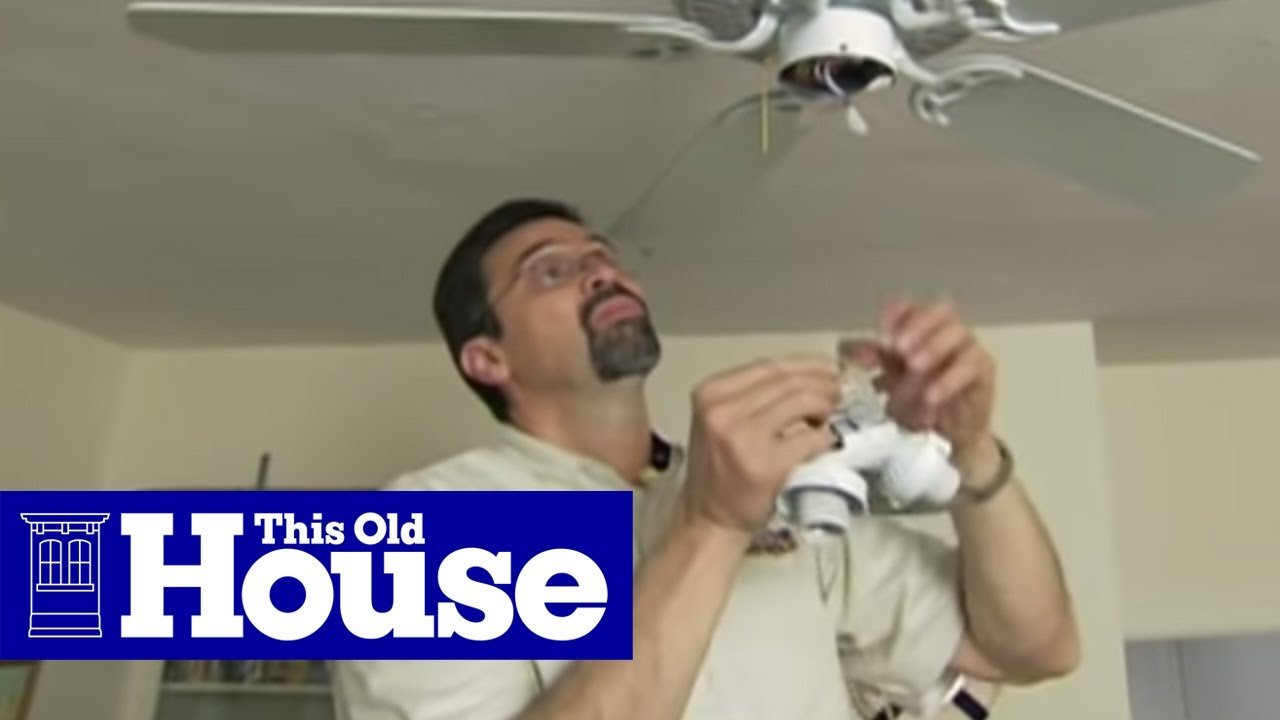
This Old House electrical contractor John Barros swaps a ceiling light fixture for a ceiling fan. The video shows shutting off the breaker, removing the pancake box, installing a fan box on older BX armored cable, and wiring the fan and its light.
Full written account
This Old House electrical contractor John Barros replaces a ceiling light fixture with a ceiling fan, and the key change is the box: the thin pancake box that held the light has to go, because a fan needs a fan box.
Safety and removal
The first step is safety. The circuit breaker is shut off downstairs before the light fixture comes down. Two small brass nuts hold the fixture, and three wires are disconnected: the black feed from the switch, the white neutral that completes the circuit, and the ground wire, which is attached to the ground screw on the fixture strap and removed with a straight screwdriver.
The fixture strap comes off next. The box is attached to the joist with two wood screws. Once it is down, a clamp is visible that joins two wires, one going to the circuit breaker panel and the other to the switch.
Pancake box versus fan box
The old box is a pancake box, thin metal that sits flush with the plaster on the ceiling. For the fan, a fan box is used instead. It is thicker steel with larger screws that can hold not only the weight of the fan but also its movement.
Older BX wiring
The house has older armored cable, called BX, a two-wire system surrounded by a metal sheath. The sheath serves as the ground. Anti-short bushings go around the cable to protect it from the sharp edges of the sheath. Both cables enter the box through one connector; tightening its screw compresses the metal sheath and creates the ground for the fan. A 1/2 in. lock nut connects the fan box to the cables, and the box is fastened to the joist with a screw gun.
Wiring the fan
The fan motor hangs from a down rod with a ball at the top, which sits on a fan bracket mounted to the fan box. Meanwhile the blades are assembled. The fan has a black wire for the fan, a blue wire for the light, a white neutral common to both, and a green ground.
The fan is controlled by its pull chain and the light by the wall switch. The hot feed from the breaker panel connects to the fan and also sends power down to the switch. When the switch is on, power returns through a wire and connects to the blue light wire. Neutrals connect together, as do the grounds. Wires are twisted together and capped with plastic wire nuts, then the canopy is secured.
Finishing
The light fixture attaches with two plug-in connections and screws onto the fan. Power is restored from the basement and the light is tested, then the fan.
Questions this video answers
What is the first safety step?
The circuit breaker is shut off at the panel in the basement before the old light fixture is removed.
Why replace the pancake box with a fan box?
A fan box is thicker steel with larger screws, so it can hold the fan's weight and its movement. A thin pancake box is made only for a light fixture.
How is the fan grounded on old BX wiring?
The metal sheath of the armored cable (BX) serves as the ground. A connector clamps the cables and compresses the sheath to act as the ground for the fan.
How are the fan and light controlled?
The fan runs from the pull chain switch and the light from the wall switch. The fan has a black wire for the fan, a blue wire for the light, a white neutral and a green ground.
Explore related projects
Connected by the topic: Electrical