Shop Vac Dust Collection from 2-Inch PVC and Blast Gates
The short version
A small-garage woodworker shows the shop vac dust collection system he set up under his workbench. It uses standard 2 in. PVC pipe joined with rubber couplings instead of glue, blast gates at the tool connection points, a Y fitting, and a paddle switch so the vac can be turned on and off without reaching under the bench. He also explains why he hasn't worried about static and how he trimmed a blast gate that sawdust kept jamming.
Full written account
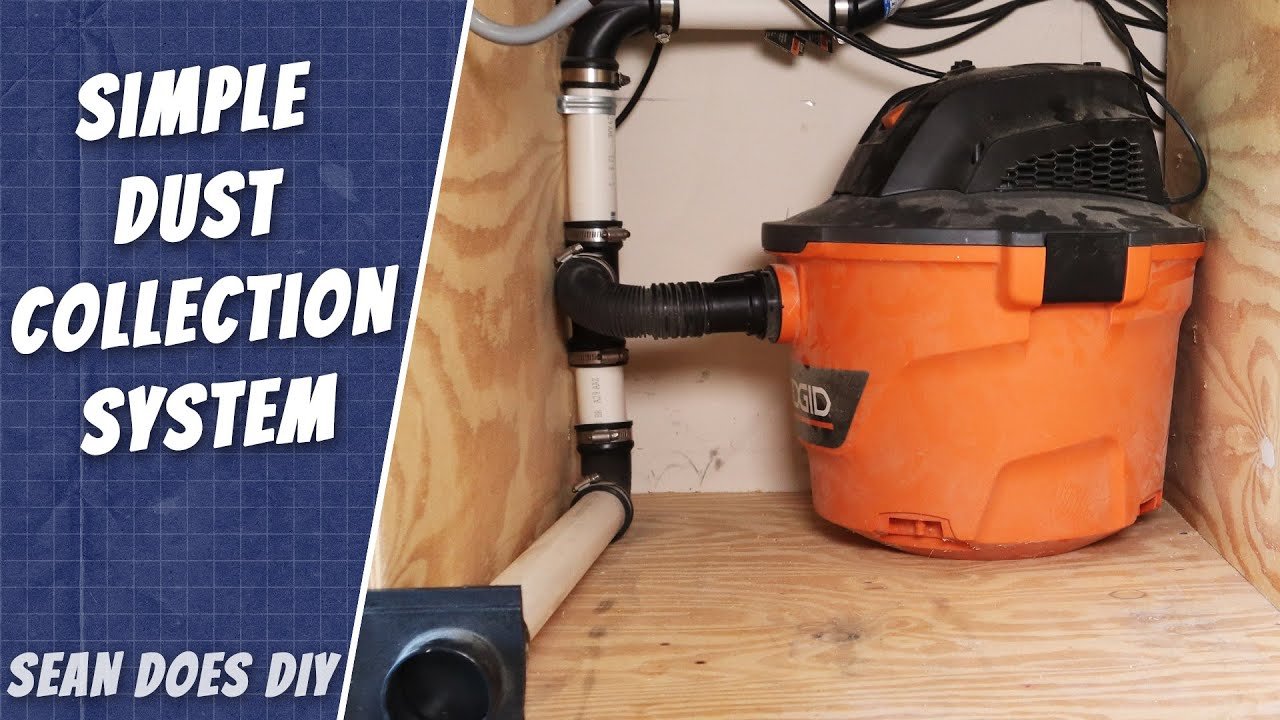
A small garage workshop doesn't need a large cyclone system with tubing run everywhere. Sean of Sean Does DIY built a dust collection setup around an ordinary shop vac, using standard 2 in. PVC pipe, rubber couplings and blast gates. Everything except the blast gates came from a big-box home store.
The layout
The shop vac sits under the workbench, shoved in without its wheels. He cut the hose that came with it so it fits into a rubber coupling. To empty the vac or clean the filter, he unclips the hose, pulls the vac out and takes it apart, then puts the hose back on and clips it down.
From there, 2 in. PVC runs to the connection points he wanted. One blast gate serves the table saw or whichever piece of equipment is out in the shop. The line then reaches a Y fitting and rises to the radial arm saw, which has its own blast gate. A few extra hoses can be hooked to the table saw, sander or band saw.
On the other side of a small wall on the bench he added a length of PVC with a cap on the end. If he later wants to reach another tool, such as the band saw, he can extend the system from it. He hasn't needed to yet.
Switch
The vac plugs into a switch with an off paddle. One end of the switch plugs into the wall and the other has a plug like an extension cord. This lets him turn the vac on and off without getting under the bench, where an air compressor and the hoses are stored.
Couplings instead of glue
He uses rubber couplings rather than gluing the PVC. If something jams in the pipe, he can take it apart, clean it out and put it back together.
Static
Someone asked about static. He notes that large systems, which move a lot of material, can build up static electricity, and that their tubing often has copper wire run through it to ground it to the blast gates. In his shop he hasn't had the issue.
Fixing a jamming blast gate
In the horizontal position, as behind the radial arm saw, the blast gates gave no trouble. In the vertical position on the table saw line, sawdust built up in one end of the gate and he couldn't shut it fully. He cut that end off on the band saw, which now pushes the sawdust out. He worried that breaking the seal would lose suction, but hasn't noticed any major loss.
Depending on the work, he runs the vac for a month or two before emptying it and cleaning the filter.
Questions this video answers
What pipe does the system use?
Standard 2 in. PVC pipe joined with rubber couplings attached to the blast gates.
Why not glue the PVC?
Rubber couplings let him take the system apart, clear anything jammed inside, and reassemble it.
How is the shop vac turned on and off?
Through a switch with an off paddle. One end plugs into the wall and the other end has a plug for the shop vac.
Does static build up in the system?
He says he hasn't had that issue so far. Large systems can build up static and use copper wire to ground the tubing and blast gates.
What problem did he have with the blast gates?
In the vertical position, sawdust built up in one end of the table saw gate so it wouldn't shut fully. He cut that end off on the band saw and noticed no major loss of suction.
How often does he empty the shop vac?
Depending on the work, he runs it for a month or two, then empties it and cleans the filter.
Explore related projects
Connected by the topic: Woodworking