Replacing a 3-Way Switch: Which Wire Goes on Which Screw
The short version
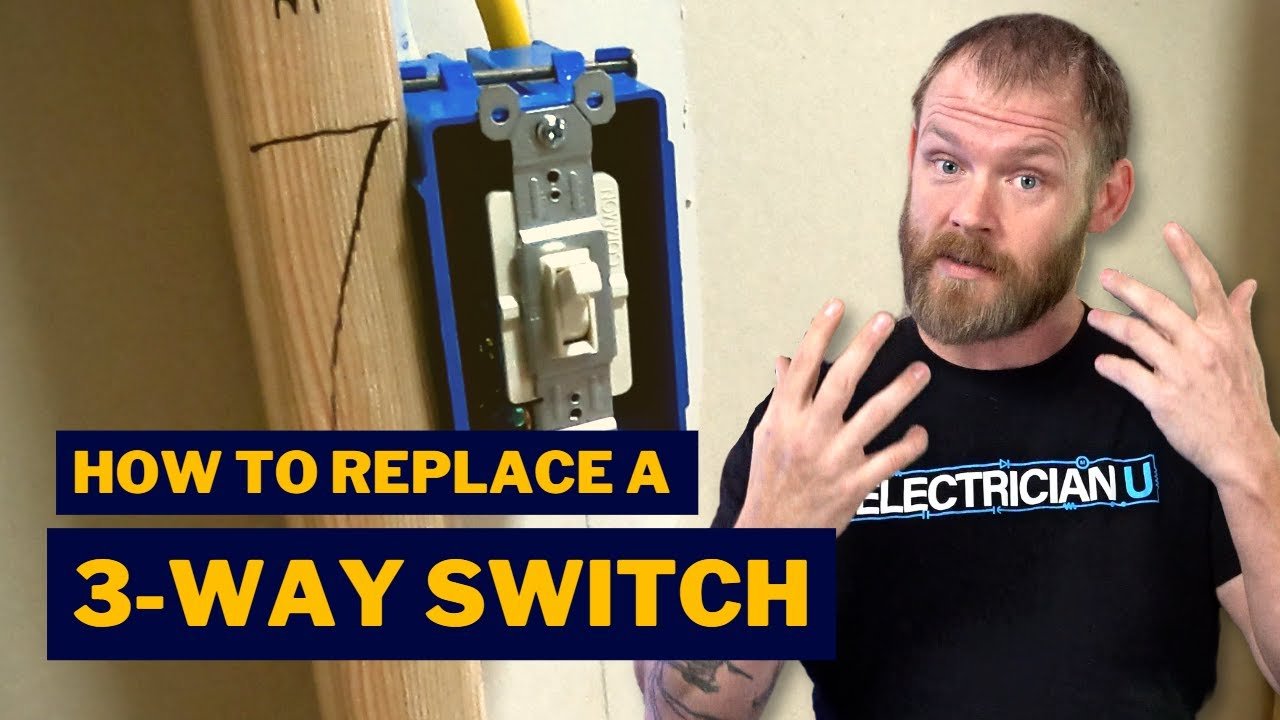
An electrician explains how to swap a 3-way switch without mixing up the wires. The common (black) screw takes the hot or the leg, and the two travelers go on the gold screws. He also shows how to identify the travelers by their shared sheathing and notes the difference between a ground fault and a short circuit.
Full written account
A replacement 3-way switch can leave a circuit working in only one position, or not at all, when the wires land on the wrong screws. A helper trimming out a house swapped an older device for a new one, and the 3-ways stopped working. Lights in a different room were switching, even though none of the wiring had changed.
What each screw does
The device has a black screw, two gold screws and a green ground screw. The black screw takes the incoming hot, or the conductor that carries power on to the next device. The other two conductors are the travelers. When the switch is flipped, power moves from one traveler to the other, and that is how a 3-way works.
If the incoming hot is put on a gold screw, the other black feeding the switch will not pass power through. Because the hot is then on a traveler, the switch only works in one position.
Taking the old device out
Power comes off first at the breaker. Some devices have a screw with a hook bent around it, while others, such as many Decora devices, have pressure plates that are tightened down. With plates, no hooks are bent.
The box in the demonstration also served as a junction box, with many other wire nuts inside. The advice is to leave those alone and take apart nothing but the device connections. Four wires should end up on the four screws, with the ground going on the green screw.
Finding the travelers if you lose track
The two travelers always come in the same sheathing. In the example, a 12-3 cable carried the travelers, which went on the two gold screws. A conductor coming from a different direction, running down to the bottom of the box in a 12-2 cable, is the hot or the leg, and it goes on the black screw. This works even when drywall hides the cables.
Putting it back
The black screw is wired first, so it does not get mixed up again. It does not matter which traveler goes on which gold screw. A screw gun does the initial tightening, followed by a final pass with a screwdriver. A torquing screwdriver is needed only if the device has torque specs, because code requires installing per manufacturer's instructions when those exist.
The ground conductor must not touch another terminal, or it causes a ground fault. A ground fault is a hot touching grounded metal. A short circuit is two hots, or a black and a white, shorting each other. After the device is back in, the breaker goes back on.
Some unusual 3-ways, such as dead-end setups, may be wired differently, but most problems with 3-ways come from the mix-up described here.
Questions this video answers
Which wires go on which screws of a 3-way switch?
The incoming hot or the leg going to the next device goes on the black (common) screw. The two travelers go on the two gold screws.
Does it matter which traveler goes on which gold screw?
No. The two travelers can go on either gold screw because the switch just alternates contact between them.
How can you tell the travelers if you lose track?
The two travelers run in the same sheathing, such as 12-3 cable, while the other conductor comes from a different direction, such as a 12-2 cable.
What happens if you mix up the wires?
If the incoming hot lands on a gold traveler screw, the switch will only work in one position and will not pass power correctly.
What safety step comes first?
Turn off power at the breaker first, then turn it back on after the device is reinstalled.
Explore related projects
Connected by the topic: Electrical