PVC Dust Collection Ductwork for a Shop With No 90° Elbows
The short version
A woodworking shop owner shows how he set up a dust collection system around a two-horsepower Central Machinery collector. He covers the cyclone separator, canister filter, collection bucket, on/off switch and an air filtration unit, then walks through PVC drain-pipe ductwork built from 45-degree and Y fittings with a blast gate at each tool. He also shows a flex hose with a floor sweep and bench wand for cleanup.
Full written account
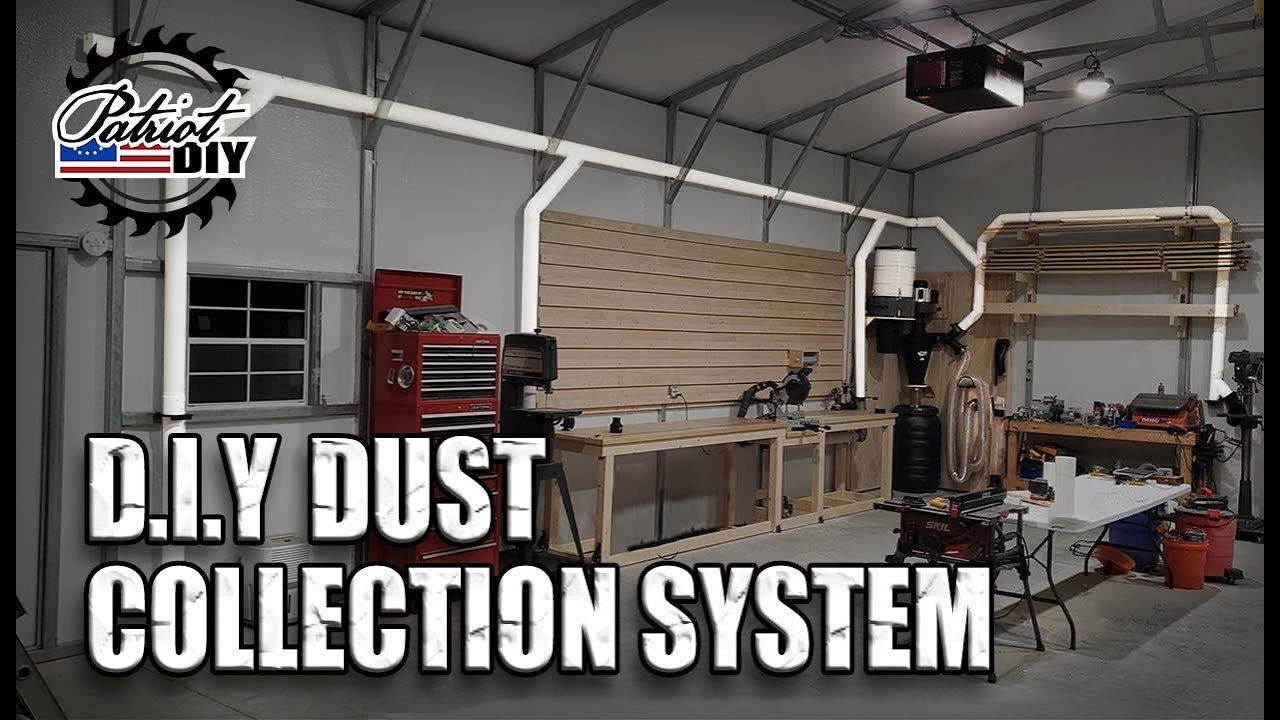
Every joint in this shop's dust collection ductwork is either a 45-degree fitting or a Y, with no 90-degree elbows at all. PatriotDIY says the goal is to avoid choking the system and get as much airflow as possible, using long straight runs and gentle curves. The tightest turn in the shop, a 90-degree corner, is made from two 45s with a short length of pipe between them.
The collector, cyclone and filter
The collector is the Central Machinery two-horsepower dust collector from Harbor Freight, mounted on the wall in an earlier video. Air from the collector passes through an Oneida Super Dust Deputy cyclone separator. Dust and chips spin inside the cyclone, and the larger material drops into a collection bin. That extends the life of the filter, which could otherwise clog quickly.
The fine dust goes on to a pleated canister filter from Wynn Environmental, used in place of the filter bags found on most collectors. It filters down to 1 micron, which matters because extra-fine dust that escapes can end up in the lungs. The video also says the pleated canister releases a larger volume of air, and since a collector can only pull in as much air as it exhales, this improves suction. A five-gallon bucket on a Gamma Seal lid sits under the canister. Because of the separator, very little dust reaches it. Since the collector sits high on the wall, an aftermarket on/off switch is routed up to the motor so it can be reached from below. He prefers it to a remote, which he expects he would lose.
PVC drain pipe ductwork
The duct is PVC sewer or drain pipe, chosen as the cheapest and easiest option. He says it is thinner walled, easier to work with and cheaper than schedule 40. Out of the cyclone, a splitter turns the 5-inch connection into two 4-inch connections: one runs up and around the shop, the other drops to a flex hose station. He recommends planning the layout and test fitting it on the floor before hanging anything.
At each drop a Y sends the pipe down at 45 degrees to another 45 fitting and straight down to a blast gate and the tool. Blast gates from Powertech sit at about waist height, and he opens only the one for the area in use. Metal banding holds the pipe in places, and on one wall existing supports carry it.
Dry fit, tape and screws
No PVC adhesive was used. The joints are friction fit, sealed with duct tape, and a screw goes into each one. Nothing is permanent, so the system can be taken apart and rerouted. Many fittings and accessories came close to fitting the drain pipe but not perfectly, so a few layers of duct tape around the blast gates and other fittings gave a tight seal. He also keeps flex hose to a minimum, since its ridges add resistance to airflow.
Cleanup and tool connections
About 40 feet of 4-inch flex hose is coiled on a wall rack of the kind sold for hanging bicycles or ladders, with the tool end sitting over a 4-inch flange. Powertech accessories include a floor sweep and a bench wand. A separate floor sweep fitting at the end of a PVC run lets him sweep debris straight into the system, and it has its own blast gate. The run ends in a cap.
The band saw sits on a rolling cart with a short flex hose. The Kobalt miter saw, which he calls poor at stock dust collection, connects through a splitter that reduces 4 inches to two 2.5-inch outlets. One goes to the saw and the other is blocked off for a planned shroud. A Y at the bottom of one drop is meant to serve a Rigid belt sander, still waiting on fittings, and a drill press.
Table saw, small tools and air filtration
The table saw still uses a fold-out table as outfeed, and he plans a table saw workbench with built-in dust collection. Sanders and the track saw use a Dustright dust separator with a shop vac. A Wynn air filtration system with a HEPA filter rated to 0.5 microns catches dust left in the air. It comes with a remote for on/off and fan speed, and a timer for one, two or four hours or as long as he is in the shop.
Questions this video answers
What pipe does he use for the ductwork?
PVC sewer or drain pipe, which he says is thinner walled, easier to work with and cheaper than schedule 40.
Is the PVC glued?
No. The joints are dry fit, sealed with duct tape, and each joint gets a screw so it won't come apart. This lets the system be taken apart and rerouted.
Why are there no 90-degree fittings?
Every joint is a 45 or a Y to avoid choking the system and keep airflow high. The tightest corner uses two 45s with a short length of pipe between them.
What does the cyclone separator do?
Larger chips and dust spin out and drop into the collection bin, which extends the life of the filter.
How fine a particle does the canister filter catch?
It filters down to 1 micron. The separate air filtration unit has a HEPA filter rated to 0.5 microns.
How does he handle small tools?
Sanders and the track saw use a Dustright dust separator paired with a shop vac.
Explore related projects
Connected by the topic: Woodworking