Plumbing Benchtop Sanders to a 4 in. Dust Collector with Blast Gate
The short version
Chris Marshall shows how he plumbed three benchtop sanders (disc, belt and spindle) to a 4 in. dust collector using a 4 in. to 2-1/2 in. StableGate blast gate, smooth 2-1/2 in. clear pipe, rubber unions, a Y-fitting and hoses. He explains why smooth pipe is preferred over ribbed pipe and how a flexible hose kit adapts the smaller spindle sander port. The system could also be connected to a shop vacuum.
Full written account
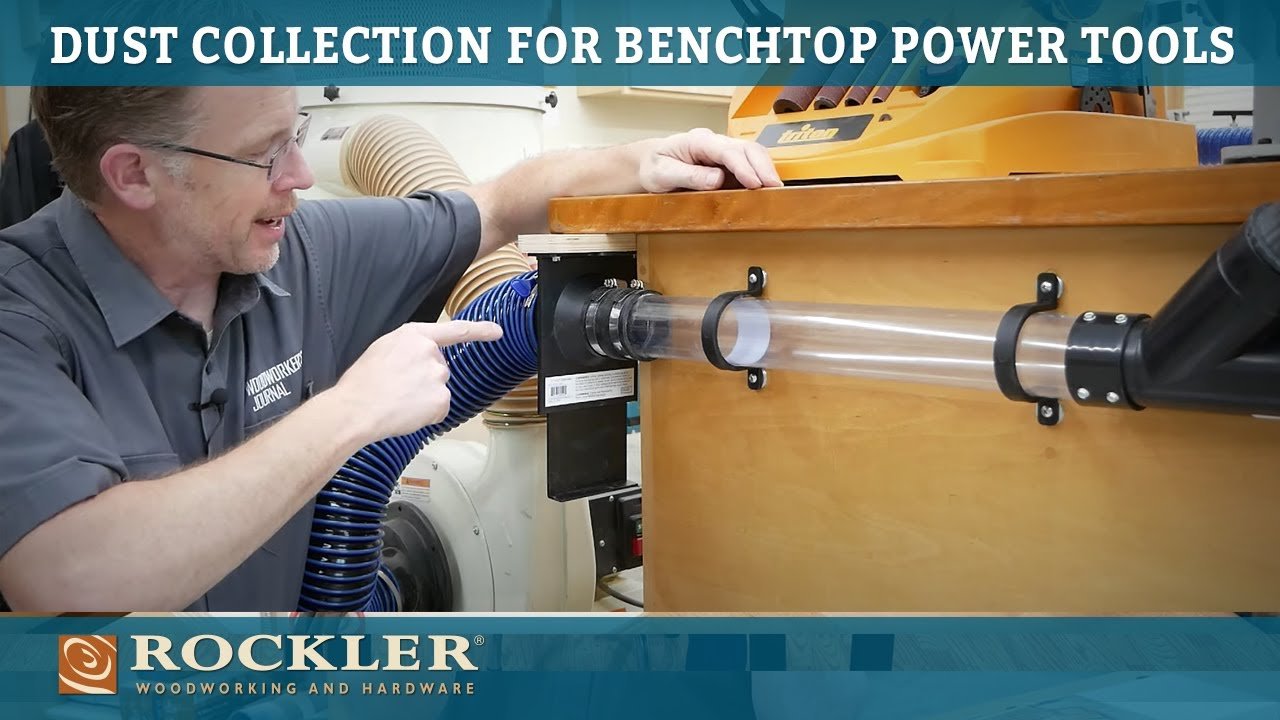
Chris Marshall of Rockler runs three benchtop sanders off a single 4 in. dust collector, and the piece that makes it work is a blast gate with a 4 in. port on one side that steps down to a 2-1/2 in. port on the other. The gate opens the air line when dust needs collecting and closes it when not, so nothing has to be unplugged and reconnected between jobs.
Why a dedicated system
Marshall had long connected sanders to a shop vacuum, which works for one tool at a time. If the vacuum is across the shop, or he is in a hurry, it becomes tempting to skip dust collection. Wood dust is messy when it accumulates and hazardous to breathe, and connecting and disconnecting tools for every use is a hassle with several benchtop tools. His answer was to plumb the tools to a dedicated system of pipes, fittings and hoses. He notes the layout would differ in every shop, and that the same system could connect to a shop vacuum or a 4 in. dust collector.
Blast gate and rubber unions
The StableGate blast gate connects to a length of 2-1/2 in. clear plastic pipe with a rubber union. A union is a soft rubber hub with two pipe clamps: slide the hub onto one side of the joint, fit the other side into place and tighten both clamps. Because the hub is pliable, it joins pipes or a pipe and fitting of the same or slightly different diameters.
Smooth pipe over ribbed
For a long run, Marshall recommends smooth pipe over ribbed pipe. The ribs create resistance that restricts airflow, while smooth pipe keeps static pressure up and air moving, and stronger airflow carries away more dust. The 2-1/2 in. clear pipe cuts with power tools or a hacksaw, and he mounts it to his cabinet back with plastic hangers made for it.
Splitting for the spindle sander
The disc sander and belt sander share the same 2-1/2 in. dust port size, but the spindle sander's port is smaller. To serve all three, he splits the airflow with a Y-fitting joined to the pipe by a 2-1/2 in. coupling. The coupling friction fits, and a few short sheet metal screws go through it into both the Y and the pipe. Another hanger bracket supports the run.
Hoses to the tools
The spindle sander connects through the FlexiPort power tool hose kit: a 12 ft length of ribbed hose that can be cut to length, four soft rubber tool adapters in different sizes, and a fitting for attaching to a 2-1/2 in. system or a shop vacuum. The components reverse thread onto the hose. One end plugs into the spindle sander and the other into the Y-fitting.
For the two sanders with matching ports, he uses a length of clear ribbed 2-1/2 in. hose with swiveling adapters on each end. The adapters friction fit into the hose ends, held by hose clamps, and into the tool ports. The plan is to plug this hose into whichever sander is in use.
Questions this video answers
Can this setup connect to a shop vacuum?
Yes. The video says the system could connect to either a shop vacuum or a 4 in. dust collector, which the presenter uses.
Why use smooth pipe instead of ribbed?
Ribs create resistance that restricts airflow. Smooth pipe keeps static pressure up and air moving, so more dust is carried away.
How is the spindle sander connected?
Its dust port is smaller than 2-1/2 in., so a FlexiPort hose kit with a soft rubber tool adapter links it to the Y-fitting.
How are the pipe and fittings held together?
Rubber unions with two pipe clamps join pipes, and a coupling friction fits with a few short sheet metal screws driven through it into the Y and pipe.
How is the clear pipe cut?
It cuts easily with power tools or a hacksaw.
Explore related projects
Connected by the topic: Woodworking