Epoxy, Flake and Polyaspartic Garage Floor: A DIY Walkthrough
The short version
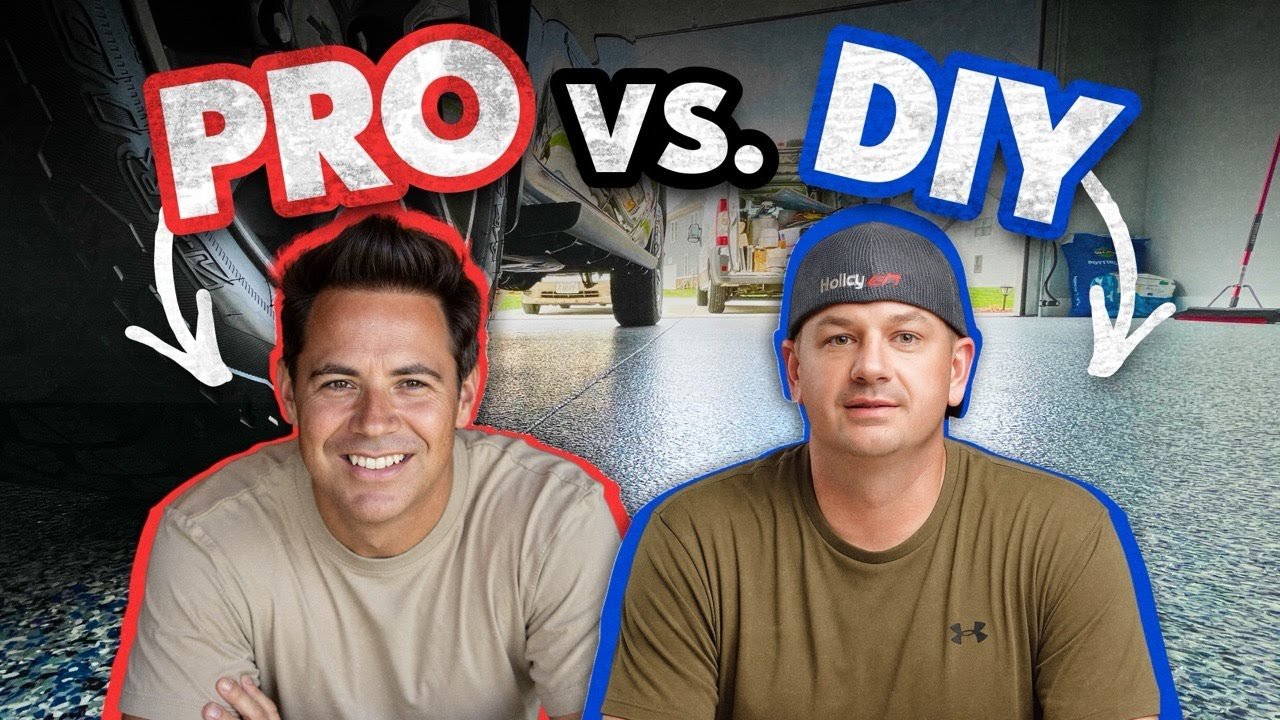
A professional concrete coater, Tim Seay, travels to Maryland to help YouTuber Joe Simpson DIY the epoxy floor of his 2,400 sq ft shop. The work covers grinding, mixing and rolling 100% solids epoxy in marked sections, broadcasting vinyl flakes, and applying a polyaspartic top coat. The video says to calculate batch coverage per kit and to work with several helpers.
Full written account
Tim Seay of Decorative Concrete of Virginia drove to Maryland to help YouTuber Joe Simpson put an epoxy, flake and polyaspartic floor in his new 2,400 sq ft car-tuning shop, with the aim of answering whether a homeowner can DIY a garage floor like a pro. Joe had said he did not want to spend over $15,000 on the floor, and his biggest worry about DIY kits was whether they would hold up.
Why grind instead of acid wash?
The first step was grinding the floor. Most DIYers rent a grinder, while the crew brought its own machine. Joe found it smaller and easier to manage than expected, and the grinding took about half a day to three quarters of a day with one machine. Seay calls the acid wash that DIY kits recommend terrible advice and says you will always run a grinder. After grinding, the crew ran a shop blaster over the floor, which is faster than vacuuming.
What goes under the flakes?
The primer was 100% solids epoxy that holds down 10 lbs of moisture. Seay says DIY kits have no moisture protection at all. In his experience insufficient prep is the number one cause of coating failures and moisture is number two, so he addresses both with prep methods and a vapor barrier primer. He recommends a decent paddle for mixing, about 5 in. across, rather than one with a tiny head.
How do you size each batch?
The floor was split into sections. The crew mixed 3 gallons at a time at 160 sq ft per gallon, which is 480 sq ft per kit. Dividing by the 40 ft width gives a mark every 12 ft down the wall, and each kit has to cover that distance. Joe said sectioning meant he was not committing to the whole floor, so he could adjust for the next section. He walked in spiked cleats, which he got used to after about 10 steps.
Flakes and the top coat
Broadcasting the flakes took the rest of the first day. Joe said the amount used was far more than he expected, and the bucket got heavy toward the end. The next day the crew scraped up and cleaned the excess. Joe reported few flakes outside the shop and no trouble finding small bolts, nuts or washers on the bright flake color.
The polyaspartic top coat followed the same method. Three-gallon kits at about 110 sq ft per gallon give 330 sq ft per kit; divided by the 40 ft width, that is a mark every 8.25 ft, and six mixes covered the garage. Joe found it thicker and more forgiving than expected, and it was laid on thicker than he anticipated.
Helpers
With one person mixing, one rolling, one squeegeeing and one doing a finish roll, the work goes smoothly. Joe's takeaway was to call in friends, and Seay joked that DIY should stand for do it with a bunch of people.
Questions this video answers
Should you acid wash concrete before an epoxy floor?
The video calls acid washing in DIY kits terrible advice and says you should always run a grinder.
How do you plan batches of epoxy?
Multiply the kit size by coverage per gallon, then divide by the room width to find how far down the wall each kit should reach. For the epoxy it uses 3-gallon kits at 160 sq ft per gallon, giving 480 sq ft per kit.
How is the polyaspartic coat divided up?
Three-gallon kits at about 110 sq ft per gallon give 330 sq ft per kit. On a 40 ft wide garage the sections are marked every 8.25 ft, and it takes six mixes.
What are the main causes of coating failure?
The video says insufficient prep is the number one cause and moisture is the number two.
Can one person do it alone?
The video says it would be really tough with one person and recommends friends helping: mixing, rolling, squeegeeing and finish rolling.
Explore related projects
Connected by the topic: Flooring