Smart Thermostat on Old Two-Wire Wiring: Reusing the Wall Wires
The short version
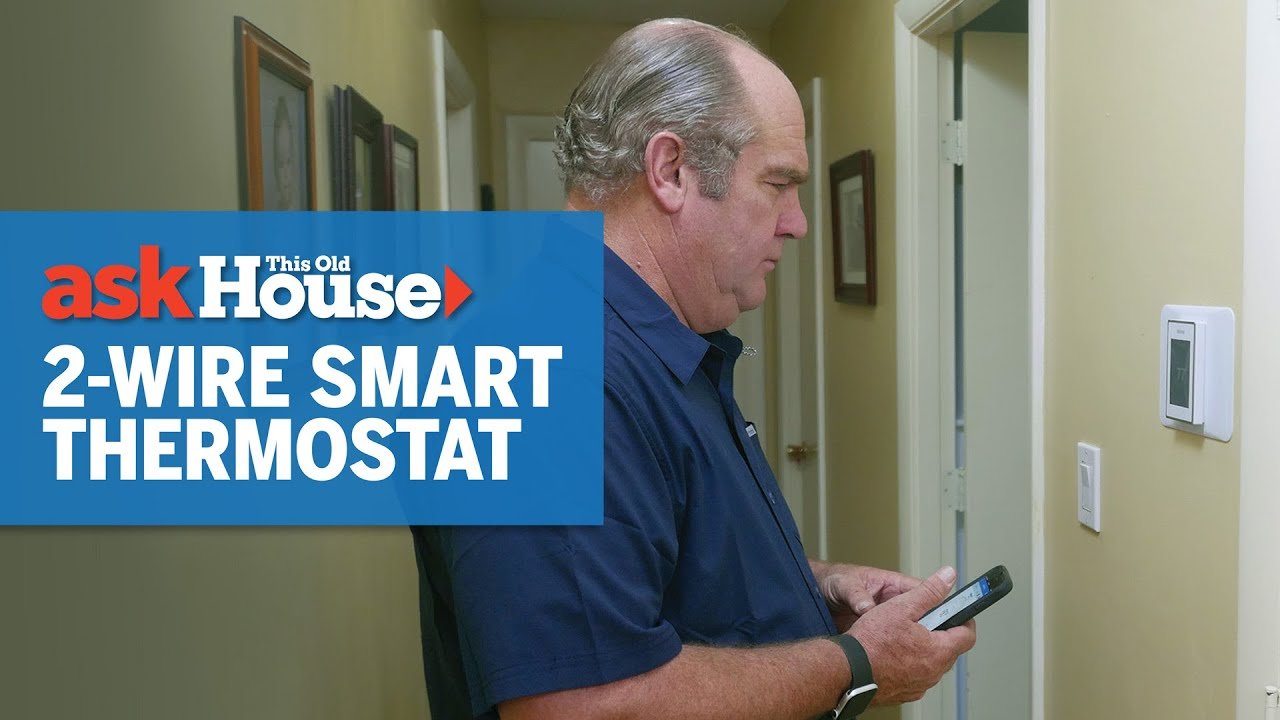
Richard Trethewey replaces a 1962-era two-wire thermostat with a smart thermostat without running new wires. A base module at the oil-fired furnace and a touch-screen unit upstairs communicate over the existing two wires, which also carry power. After the furnace service switch is turned back on, the thermostat runs and is controlled from a phone.
Full written account
Richard Trethewey of Ask This Old House replaces a thermostat in a house he says was built in 1962, using only the two wires already in the wall. The homeowner, Michael, had an energy audit that suggested a programmable thermostat, but found his wiring was not compatible with a new unit.
The problem with two wires
The old thermostat has no heat/cool switch, so Richard assumes the system is heating only. It works as a simple switch: heat needed or not. A programmable model with a battery could power a clock, but would have the same on and off periods each day and could not be reached from the internet. A modern internet-connected thermostat needs at least a third wire to power it, and a system with heating and AC needs at least five. Running or fishing new wires down to the furnace is not always easy.
Removing the old unit
The furnace service switch is turned off first. Richard explains that older thermostats sensed temperature in different ways: sometimes a mercury-filled bulb that tipped to make or break the circuit, and in this case a bimetallic sensor with a spring. A couple of screws hold it, and then the base plate comes off. He notes the wall might need touch-up or a new base plate.
A two-piece smart thermostat
In the basement is an oil-fired furnace with ductwork out and a return coming in. A typical smart thermostat has a sensor inside the home, a Wi-Fi connection and generally five wires. The unit used here splits those functions into two pieces: a touch-screen user interface with sensor and Wi-Fi upstairs, and a base module at the furnace. The two wires become a digital link between them, and the base module supplies power upstairs. The module also allows later additions such as air conditioning, ventilation or humidity control.
Wiring and mounting
Richard mounts the module on a pegboard in a central location. The two thermostat wires go to the terminal marked for the thermostat, and he says it does not matter which is which because the connection is not polarity sensitive. At the furnace, the connections are R, W and C: red to R, white to W, and the blue wire to common, which powers the whole rig. Upstairs, the new wall plate covers the patch left by the old unit. After a pilot hole is drilled and the plate fastened, the unit is pushed onto its connections and the wires are fed into the wall.
Power on
With the furnace power back on, the thermostat runs. Settings can be changed on the screen and from a phone, which allows remote adjustment, a check on operation and a look at how often the system came on during a month.
Sensor location and wireless
The sensor and control remain in the hallway. For a different location such as the master bedroom, a separate sensor disc exists, but two wires would have to be run down to the module. Richard says wireless indoor thermostats exist, but frequent transmission wears down batteries and radio frequency interference is a concern, so he prefers a wire to carry the digital signal.
Questions this video answers
Can a smart thermostat reuse an old two-wire setup?
Yes. The two wires in the wall become a digital link between a base module at the furnace and the touch-screen unit upstairs, and the base module powers the upstairs unit.
Does it matter which of the two wires goes to which terminal?
No. He says it does not matter which of the two wires goes where, because the connection is not polarity sensitive.
What power step does the video show?
The video has the furnace service switch turned off before the work and turned back on afterward to test.
How many wires do modern thermostats usually need?
He says a modern heating and AC system would need at least five wires, and any modern thermostat needs at least a third wire to power it.
Can the sensor be put in a different room?
Yes. He says you could run two wires from a sensor disc in another room, such as the master bedroom, down to the base module.
Explore related projects
Connected by the topic: Electrical