Wall-Mounted Garage Door Opener: Torsion Bar Install and Sensors
The short version
A Lowe's associate guides two homeowners through replacing a missing ceiling opener with a wall-mounted (jackshaft) garage door opener on the torsion bar. The video covers the space requirements, mounting the unit to a stud, installing the automatic lock, control panel, safety sensors and battery backup, then testing the safety reversal with a board and a ball. It tells viewers to follow the owner's manual for programming.
Full written account
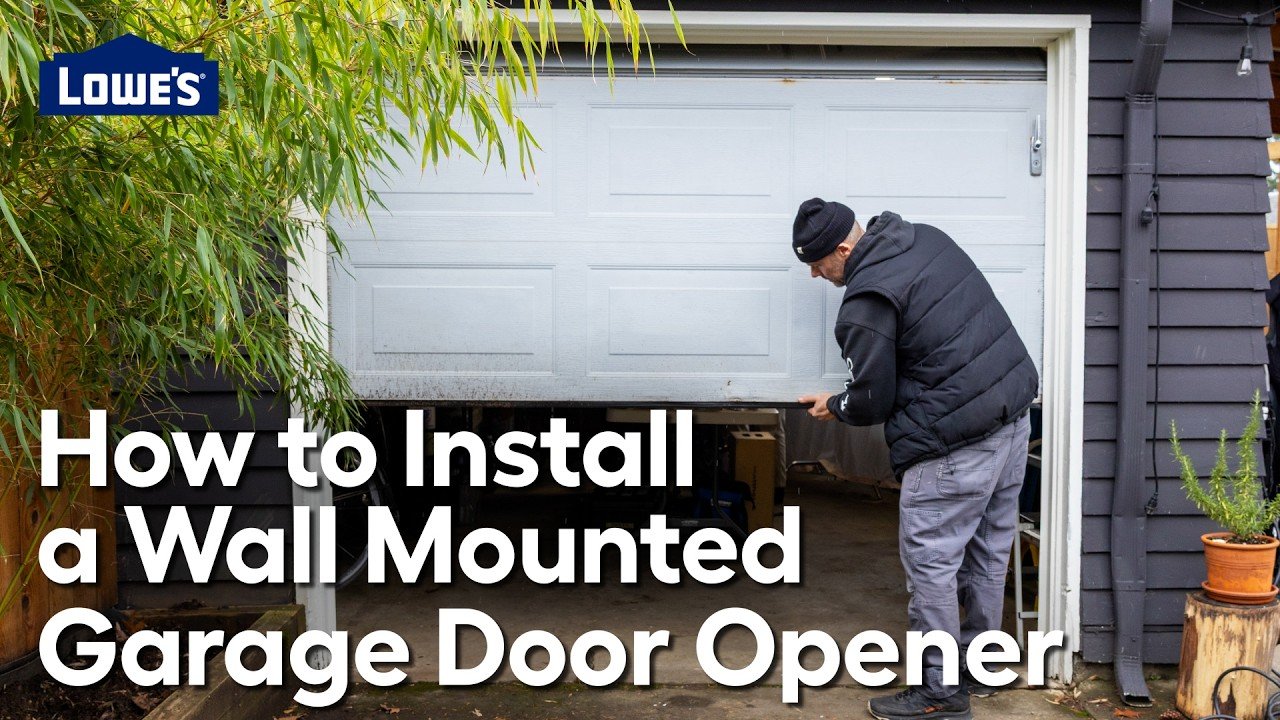
Amy and Jim's garage is not attached to their house, and the garage door is the only way in. The previous ceiling-mounted opener was broken, and Jim removed it because it took up too much overhead space. They want to fit a large van in the garage, which it barely does. A Lowe's Red Vest associate, Caroline, suggests a wall-mounted opener, described as space-saving and ultra-quiet, with an automatic lock.
Checking the requirements
The door must be sectional and no larger than 180 sq ft. Any gap where the door meets the floor should be a quarter inch or less. The torsion bar must be 1 inch in diameter and extend beyond the bearing plate by an inch and a half. Other measurements: at least 3 inches above the torsion bar, 8.5 inches from the end of the bar to the wall, and at least 2 and 1/2 inches of clearance from the door edge to the wall. The drum on the end of the rod should be between 3 and 6 inches in diameter. A 120-V outlet must be within 6 feet of the door.
The door balance is tested by lifting it 3 to 4 feet off the ground, where it should stay in place. The opener cannot be attached solely to drywall. Because the walls are unfinished, it mounts to the studs.
Mounting the opener
The collar slides onto the motor shaft on the right side, with the bolts facing up. The two inner screws are hand-tightened, then finished with a 3/8 inch open-end wrench. The mounting bracket goes on the same side. With the opener lifted onto the torsion bar and the collar bolts snugged, a level confirms it is parallel to the door. After marking the bracket holes, the opener comes off and 3/16 in pilot holes are drilled into the stud. Once it is back on and rechecked for level, the collar bolts are fully tightened and the bracket is secured. A red emergency release rope is attached to the bottom.
Lock, panel and sensors
The lock mounts on the same side as the opener, on the door track just above the third roller. Here that spot would block a light switch and plug, so they use the second roller. The roller position is marked, with a second mark 3 and 1/4 in above it. A template is attached to the track, 1/8 in pilot holes are drilled, and a step drill bit makes the 5/16 in and 3/4 in holes. Rough edges are cleaned with a metal file. The lock is attached without power tools and without over-tightening, and the lock cable goes to the lock terminal.
The control panel goes inside the door at least 5 ft high, away from moving parts, with the opener unplugged. Red and white wires match the labeled spots, red to red and white to white.
Two low-mounted sensors detect pets or objects under the door. Brackets snap onto the track no more than 6 in from the floor. The sensor wires are twisted white to white and black to black and attached to the quick connect terminals. After plugging in, the sensor under the opener should show a solid amber light and the other a solid green light.
Battery backup and testing
The battery backup needs gloves and protective eyewear, and the opener is unplugged first. Red connects to red and black to black. When plugged back in, a solid green LED means the battery is charged and connected, while a flashing green LED means it is charging.
Programming varies by model, so the owner's manual is followed. The safety test puts a board under the center of the open door, which should reverse and reopen fully, then repeats with a ball.
Questions this video answers
What size garage door works with a wall-mounted opener?
The door must be sectional and no larger than 180 sq ft, with any gap at the floor a quarter inch or less.
What torsion bar size is required?
The bar must be 1 inch in diameter and extend beyond the bearing plate by an inch and a half.
Where should the outlet be?
A 120-V outlet within 6 feet of the garage door. Extension cords and adapters should not be used.
Can the opener be mounted to drywall?
No. It cannot be attached solely to drywall; in this garage it was mounted directly to the studs.
How is the safety reversal tested?
Place a board under the center of the open door; the door should hit it, reverse and reopen fully. Then repeat with a moving object like a ball.
Explore related projects
Connected by the topic: Doors and windows