Running Underground Power to a Shed: Trench, Conduit and Panel
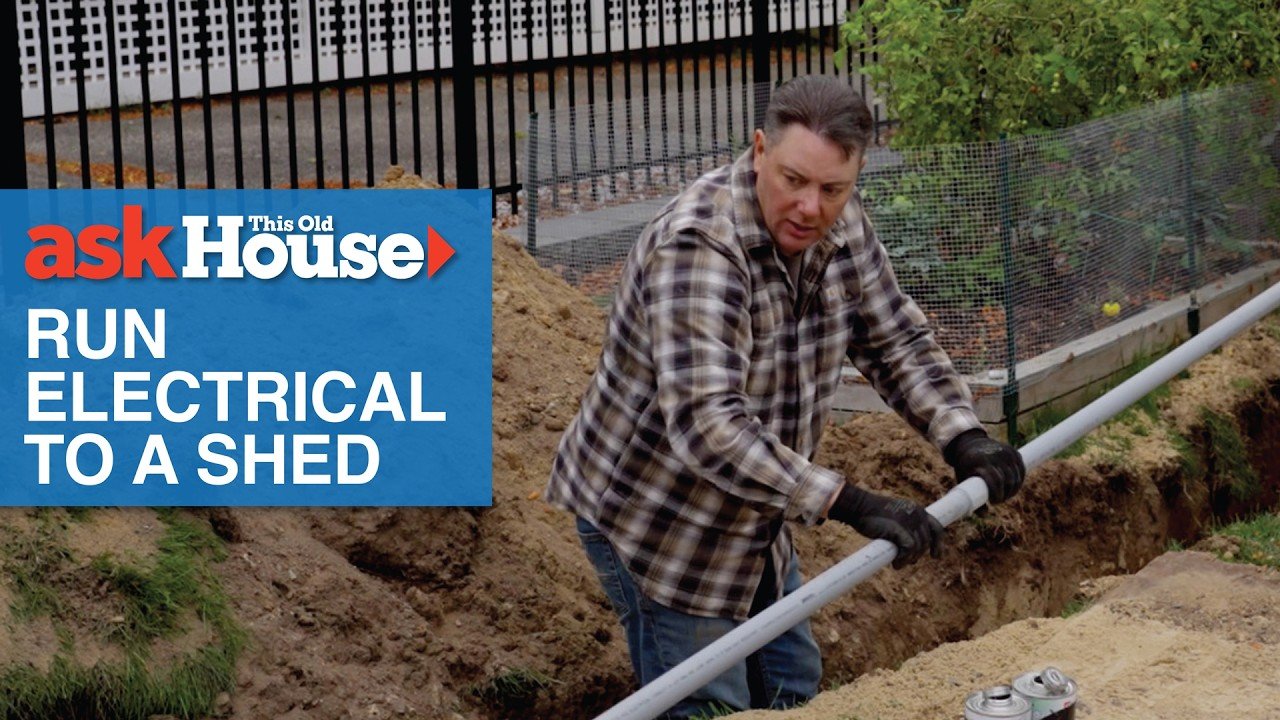
The short version
Master electrician Heath Eastman runs underground electrical power from a home's basement panel to a new shed for a homeowner, Jeff. The work covers a trench with sand and conduit, ground rods, metallic caution tape, pulling wire, and a new panel and circuits in the shed. The video says new circuits in the main panel should be done only by a licensed electrician.
Full written account
Master electrician Heath Eastman ran underground power from a home's basement panel to a new shed, and one of the first constraints he found was the panel itself: it is not rated for tandem breakers, so he needed to free up space by removing receptacles on an old workbench that the homeowner, Jeff, no longer used. A new two-pole 60 amp breaker went in that space.
Planning the route
Jeff wanted the shed split, with the right side for storage and the other half a place to work on and paint things. Heath proposed a panel in the shed, an eight-foot LED light, a couple of outside lights and general receptacles, with room to grow if it became more of a wood shop. The crawl space at the back of the house was not accessible, so the route went to the corner and into the regular basement, between an old coal chute and a window. Inside, Heath kept the entry on one side of a joist, away from the plumbing pipes going upstairs.
Trench and fittings
Digsafe had already been called. The target was 18 inches to the top of the pipe, so the trench went down about two feet, leaving a couple of inches of sand below the conduit. Sand also surrounds the conduit because rocks could be pushed up by frost. At the house, Heath mounted an LB fitting and an expansion fitting, designed to move up and down with frost heave without damaging the wire, the pipe or the building. He set it above grade and planned to seal around it with a bead of caulk.
Conduit
The conduit was glued up on the grass rather than in the trench. The bell end faces downhill because the yard pitches from the house toward the shed, so water runs around the fitting instead of into a joint where the glue might not have set properly. A light cap on the open end keeps sand out. The conduit was oversized for future use.
Grounding and warning tape
Two 8-foot ground rods were driven six feet apart and joined with bare number 6 wire, with a connector slid down so the wire was not cut. With the trench about six inches below grade, metallic caution tape went in before the final grade. It warns anyone digging later and is traceable with a tone, with a tail left accessible.
Pulling wire and wiring the shed
Heath sent a fish tape through the conduit, tied on the pull line, and taped the front of the wire to smooth any edges. Jeff fed it while Heath pulled. When power goes to an outbuilding like this, there must be at least one receptacle and one light. The shed got a receptacle for a possible fridge, the LED light and an outside light over the door. The video states that adding circuits to the main panel should be done only by a licensed electrician with the service completely disconnected.
Explore related projects
Connected by the topic: Electrical