Replacing a Water Heater Anode Rod That Has Fully Corroded Away
The short version
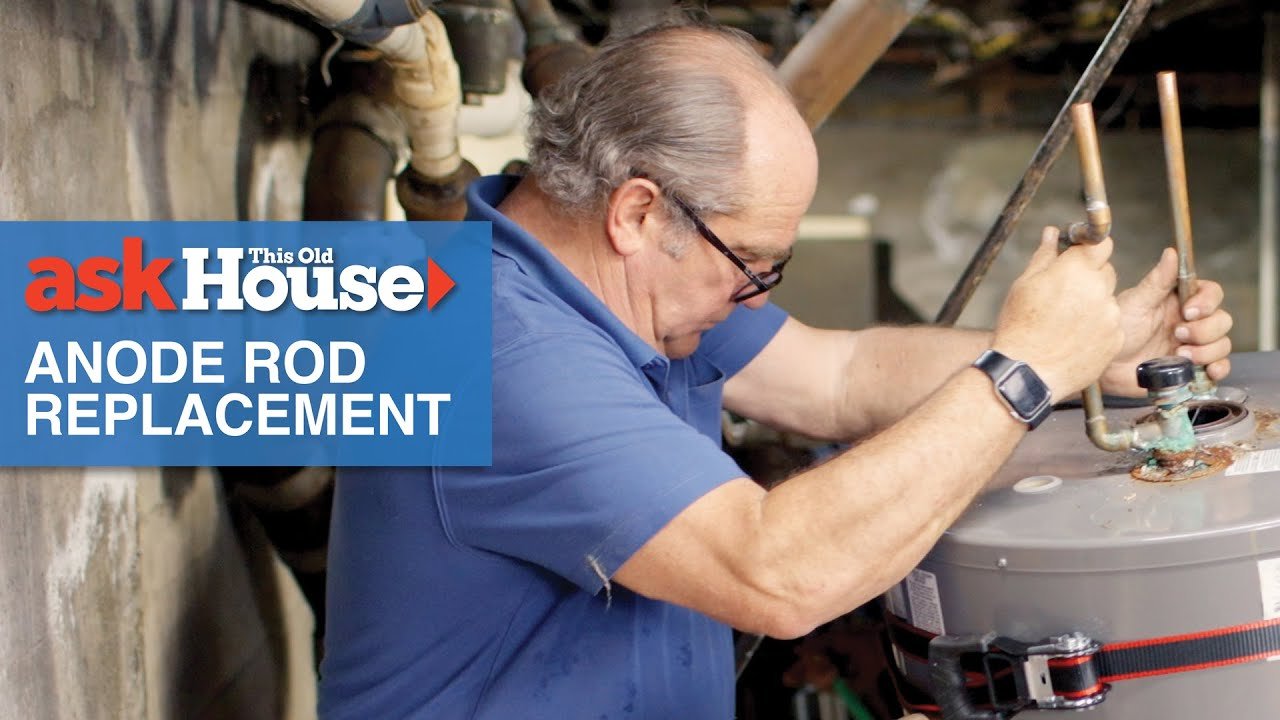
Richard from Ask This Old House helps a homeowner replace the anode rod on an eight-year-old water heater. He explains what the sacrificial rod does, how to drain the tank partway, and how to back out a stuck rod with a ratchet, strap and impact gun. The old rod turned out to be completely gone.
Full written account
An eight-year-old water heater in a basement had a note from the prior owner saying its anode rod should have been changed a couple of years earlier. Homeowner Brennan did not know what an anode rod was, what it does, or how to change it. Richard, on Ask This Old House, showed him, and found that the rod was gone entirely.
What the anode rod does
Every water heater has an anode rod, made of aluminum, magnesium or sometimes zinc. It sits inside the tank and is sacrificial: it is designed to take the corrosion and electrolysis that naturally happen in water, instead of the tank, which is glass-lined steel. If the glass lining has imperfections, the electrolysis would attack the steel, but it attacks the rod first while the rod is still operational.
Richard showed a rod from a water heater about 10 years old, where little was left. Once the anode was gone, that heater showed rust and ultimately leaked. He said changing the anode every two to five years could make a water heater last almost indefinitely, 20 years versus 10. The part costs about $40, and the difficulty is often getting it into the tank. A replacement made to bend, with a tapping on it, can be curved to fit down in.
Draining and preparing
The tank is drained only partway, to about half a bucket, so the weight of the water holds it in place while the rod is backed out. Richard turned the water off, put a hose on the drain valve and opened hot-water faucets upstairs to vent the piping. The water first came out funky, and he noted the tank bottom collects sediment, which affects fire-to-water transfer. His tip was to take a little water out every six months. The gas or electricity also gets turned off, depending on the heater.
Getting the old rod out
Anode heads are a standard 1 1/16 in. A 12-point socket fits, and the simplest approach is a breaker bar with a ratchet. A rod left in for years tends to fuse in, which calls for a heavy-gauge ratchet and a pipe extender. More force risks the water heater moving and bending the pipes, gas connection and vent, so he suggested a strap with a second person holding back.
The last resort is an impact gun with a six-point socket, since the nut has six sides and a 12-point socket could round it over. An impact gun gives high torque at low speed. The ratchet attempts failed, so Brennan used the impact gun, and the rod came out finger-tight. There was no anode rod left.
Installing the new one
Richard put Teflon tape on the threads, bent the flexible rod to get it in, then straightened it so it hangs straight down. Brennan started the thread without crossing it. Given the corrosion, Richard thought the heater might leak within two weeks. A new heater costs about 1,000, and if the rod lets one last 20 to 25 years, he said, it is worth it. He asked Brennan to change the anode every two to three years.
Questions this video answers
How often should a water heater anode rod be replaced?
Richard says it should be changed regularly, and recommends every two to five years; later he says every two to three years.
What does an anode rod do?
It is a sacrificial rod of aluminum, magnesium or sometimes zinc that sits inside the tank and takes the corrosion and electrolysis that would otherwise attack the glass-lined steel tank.
What size socket removes an anode rod?
A 1 1/16 in. socket. Richard says the head size is standard and the usual socket is 12-point, but a six-point socket grips the six-sided nut better and is less likely to round it over.
Should the tank be fully drained?
Drain the tank down only partly, to about half a bucket of water out, so the weight of the water holds the tank in place while the rod is backed out. Turn off the water and the gas or electricity, and open hot-water faucets upstairs to vent.
How much does an anode rod cost?
He says the replacement anode is a $40 part and a new water heater is about 1,000.
Explore related projects
Connected by the topic: Plumbing