Gas Furnace Not Starting: Five Checks Before Calling a Contractor
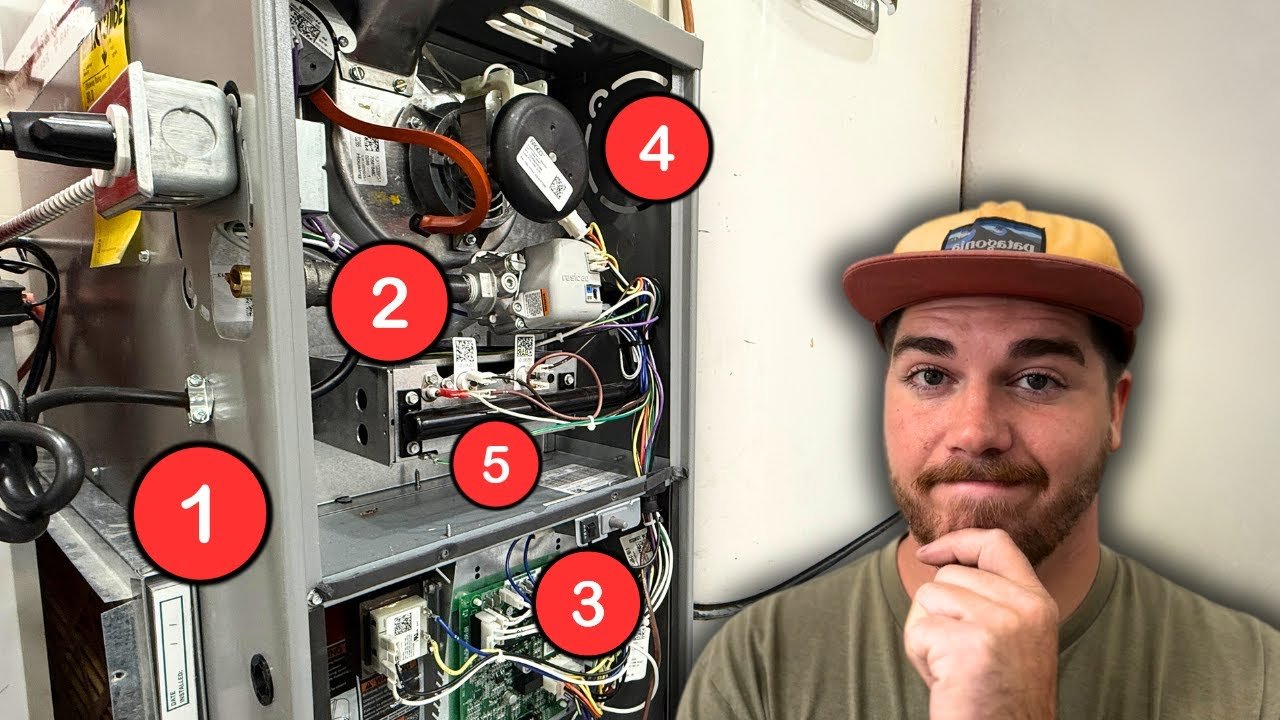
The short version
An HVAC contractor shows five checks to make on a gas furnace that won't turn on before calling a contractor: air filter, flame sensor, blower motor and capacitor, inducer motor and vents, and the igniter. He first says to read the flashing diagnostic code through the sight glass before any reset. He also covers a 3 amp board fuse and capacitor testing.
Full written account
A gas furnace that won't turn on often has a simple cause, and an HVAC contractor lists five things a homeowner can check before calling for service. Before anything else, he says to read the code flashing on the LED visible through the furnace's sight glass, because the code erases itself as soon as the furnace is reset.
Read the diagnostic code first
Every furnace has this LED for diagnostic codes. The number of flashes gives a general idea of what is wrong, though it does not name the fault directly, and several issues can share one code.
1. Air filter
A badly clogged filter is a frequent reason a gas furnace isn't working. Without enough air through the heat exchanger, the furnace overheats, and a sensor on the firewall turns the system down. If the filter is dirty, replace it and reset the furnace by flipping the switch or, on a plugged-in unit, unplugging it for 10 to 15 seconds. Years of a dirty filter can also clog the coil, which is typically A-shaped and sometimes N-shaped, at the apex where air is blown in. This is less common, since it takes a lot of debris.
2. Flame sensor
If the flame appears at the burners and then turns off after a couple of seconds, the flame sensor is probably dirty. It is held by one screw: remove it, clean it, put it back. Dirty filters and dirty flame sensors account for a lot of service calls.
3. Blower motor, capacitor and fuse
With the switch off or the furnace unplugged and the door switch disengaged, spin the blower wheel by hand. Free spinning means the motor is probably fine; a seized, hard-to-spin wheel suggests a new motor.
The capacitor can retain energy, so with power off, touch its two leads together with an insulated screwdriver to discharge it. A 20 µF capacitor tested on the meter's capacitance setting read 18.8, below the plus or minus 5% tolerance printed on it, so it was judged bad. A reading far lower, or OL, means it is bad. Prongs that mushroom out and point diagonally, or leaking fluid, are also signs. Replacement must match the rating and voltage.
On the older board shown, a 3 amp fuse is worth checking: a blown one shows black discoloration and a broken metal Z inside.
4. Inducer motor and venting
The inducer is the first thing to come on and should sound smooth, with no metal-on-metal grinding. Something slowing it can trip the pressure switch and keep the furnace from starting. A restricted exhaust or intake can do the same; he has seen hornets' nests and dirt daubers inside an exhaust flue. Check the PVC vent outside the home for a clog.
5. Igniter
About 30 seconds after the inducer starts, an orange glow should appear in the burner area. That is the hot surface igniter, which gets cherry red; the gas valve then opens and the hot igniter lights the gas, after which it loses voltage. If the inducer runs but there is no glow, there is a problem. Hot surface igniters are the ones that mainly go bad, while spark igniters rarely do. The igniter is held by one screw and has two wires; the single wire belongs to the flame sensor. Broken bits in the burner assembly point to a brittle igniter. A universal replacement goes in the same hole, lined up with the side of the burner, and connects with wire nuts, with polarity not mattering.
Other causes are possible, but he says a gas furnace is fairly basic and the code narrows it down.
Questions this video answers
What should I do first when a furnace won't turn on?
Look through the sight glass at the LED and note the flashing diagnostic code before you reset the furnace. The code erases itself as soon as you reset it.
Why can a dirty air filter stop a furnace?
A clogged filter limits airflow through the heat exchanger, so the furnace can overheat. A sensor on the firewall turns the system down when it overheats.
How do I check the blower motor?
Spin the blower wheel with the power off or unplugged and the door switch disengaged. If it spins freely the motor is probably fine; if it is seized or hard to spin, it probably needs replacing.
How do I safely test a capacitor?
Capacitors can retain energy. With the power fully off, touch the two leads together with an insulated screwdriver to discharge it. Then test it with a meter on the capacitance setting.
How can I tell if the igniter is bad?
If the inducer runs but you never see the orange glow in the burner area, the hot surface igniter is likely the problem. Hot surface igniters are the ones that mainly go bad.