Epoxy Coating a Garage Floor: Etch, Roll Two Coats, Add Flakes
The short version
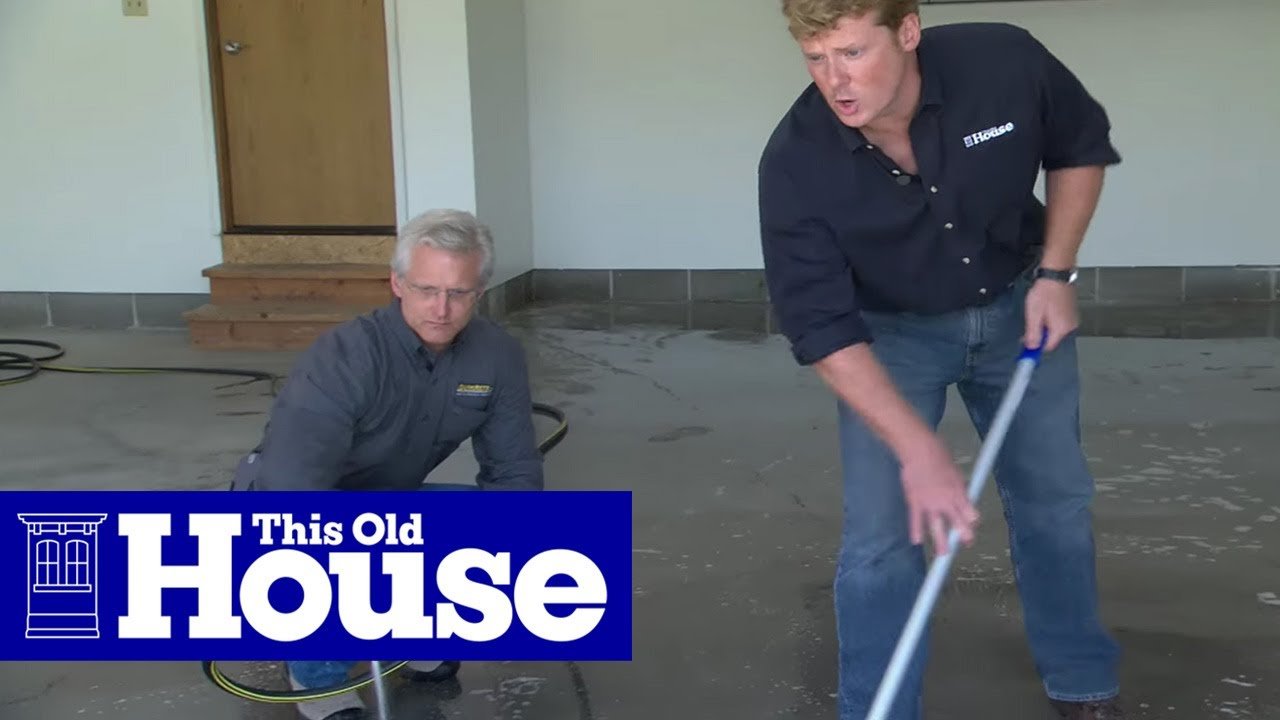
This Old House host Kevin O'Connor helps epoxy-coating expert Doug Fasching coat a garage floor. They test for a sealer with water, spot degrease, acid-etch, rinse and vacuum, then mix and roll a two-part epoxy. A second coat goes on the next day with color flakes broadcast into the wet epoxy.
Full written account
Before any epoxy goes on a garage floor, This Old House host Kevin O'Connor and epoxy-coating expert Doug Fasching start with a spray of water. If the water soaks in, there is no cure and seal on the concrete. Where it pulls away, as it did in one area of this floor, the spot needs degreasing.
Preparing the surface
Fasching degreases the problem spots while water keeps going on the rest of the floor to find more. The degreaser is biodegradable and environmentally friendly, so washing it off into the driveway is not a concern.
Next comes acid etching. The crew wears rubber boots, gloves and goggles. One container of acid goes into two gallons of water, applied from a plastic sprinkling can, because acid reacts with metal. The floor must be damp so the acid can flow out. The acid reacts with the concrete surface, which gives good mechanical adhesion.
Afterward the floor is rinsed to remove dirt and loose particles. The acid has reacted with the concrete and become a salt, so rinsing it into the driveway is not a concern. A wet vac removes the tiny particles the reaction leaves behind. The floor must be completely dry before epoxy goes down.
Mixing and rolling
The epoxy comes in two parts, A and B, mixed together so the chemical reaction occurs. After mixing well, wait 30 minutes before application. Pot life is two to two and a half hours, so no more than needed should be mixed ahead of time.
Fasching recommends working in an area about two feet deep by six feet wide, then using finishing strokes in a perpendicular direction.
Second coat and color flakes
One coat looks good, but the next morning a few places are thin and not uniform. A second coat fixes that. The floor needs the second coat, but not the walls.
Color flakes add a decorative effect and help hide imperfections. They go into the epoxy while it is still wet so they adhere well.
Questions this video answers
How do you check whether a garage floor already has a sealer?
Spray water on the floor. If it soaks in, there is no cure and seal. Areas where the water pulls away need spot degreasing.
Why use a plastic sprinkling can for the acid?
Acid reacts with metal, so a plastic can is used.
How long can mixed epoxy be worked?
After mixing parts A and B, wait 30 minutes; the epoxy then has two to two and a half hours of pot life.
How big an area should you paint at a time?
Work in an area about two feet deep by six feet wide, finishing with strokes in a perpendicular direction.
When do the color flakes go down?
Into the wet epoxy so they adhere well; they also help hide imperfections.
Explore related projects
Connected by the topic: Flooring